
Whether you’re a beginner just picking up a racket, a coach guiding young athletes, or a club player trying to avoid those pesky service faults, understanding the rules of badminton is the key to enjoying the game. The Laws aren’t just for international tournaments -they keep rallies fair, fast, and fun in every hall and backyard. This guide breaks down the official BWF Laws of Badminton in plain, easy‑to‑grasp language, with a few coaching tips sprinkled in so you can focus on your shots instead of scratching your head over technicalities.
Table of Contents
What’s new or clarified since recent seasons?
- Spin serve is out, permanently. The server must release the shuttle without adding spin and initially strike the base.
- Fixed service height is in the Laws. At impact, the whole shuttle must be below 1.15 m from the court surface.
- Scoring remains 21‑point rally scoring (best of 3) at all standard events. A separate 3×15 (cap 21) system is being trialled at selected events; it does not replace the standard system unless specified by the event.
Tip: If you’re coaching, add a visible “Updated on” line at the top of your team handouts and remind servers to practice clean releases with the SHMD (service height device) in mind.
What is the badminton court dimension?
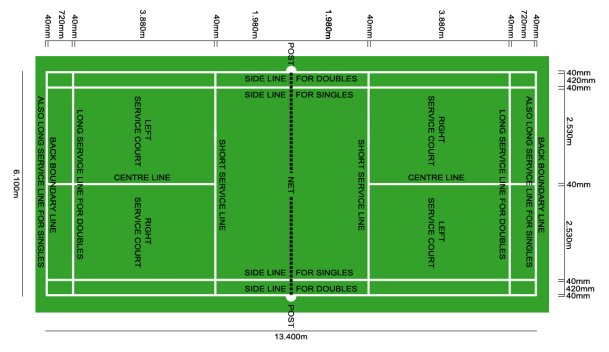
A badminton court measures 6.1m wide and 13.1m long. Across the rectangular court, there is a net in between than runs at 1.55m. There are two tram lines on each side of the court. The inside lines are a boundary for singles matches and the outside lines are a boundary for doubles matches. Lets explore the badminton court and equipment in detail below:
- Court size (doubles): 13.40 m × 6.10 m.
- Singles side lines: the inner, narrower lines; doubles uses the outer side lines.
- Short service line: 1.98 m from the net; long service line for doubles is shorter than singles (0.76 m inside the back boundary).
- Net height: 1.524 m at centre, 1.55 m at posts.
- Shuttle: traditionally 16‑feather with a cork base (or approved synthetic alternatives).
- Racket: must conform to BWF specs; no devices that materially alter its shape during play.
Coach note: Tape a thin cord at 1.15 m on a wall to give servers a visual for legal contact height during drills.
What is the match format and scoring system used in badminton?
A badminton match always begins with a toss. If you win the toss you have an option to choose either to serve first or to start play at either side of the court. Your opponent will exercise the remaining choice.
- A match in badminton is a best of three games.
- Each game is set for 21 points and the side to achieve 21 points first, wins the game.
- Rally scoring to 21. Every rally scores a point.
- Win by 2 (e.g., 21–19). If it reaches 29‑all, first to 30 wins the game.
- First serve of next game goes to the side that won the previous game.
Intervals & change of ends
Change ends: end of game 1; end of game 2 (if a game 3 will be played); and during game 3 when a side first reaches 11.
Mid‑game interval: up to 60 seconds when the leading side hits 11 points.
Between games: up to 120 seconds.
What are the service rules in badminton?
To deliver a legal service:
- Be ready: Server and receiver should stand inside diagonally opposite service courts without touching the boundary lines.
- Feet still: Part of both feet of server and receiver must touch the court, stationary from the start of service until the shuttle is hit.
- No delay: Once set, do not cause undue delay.
- Release correctly: The server should release the shuttle with no spin and initially strikes the base.
- Height: At impact, the whole shuttle is below 1.15 m from the court surface.
- Racket motion: One continuous forward movement until the shuttle is hit.
- Don’t miss: Attempting to serve and missing the shuttle is a fault.
Start of service = the first forward movement of the server’s racket. Service is delivered when the shuttle is struck (or missed).
Singles vs Doubles service courts
- Singles:
- Server’s score even → serve from right; odd → left.
- Receiver stands in the diagonally opposite court.
- Doubles:
- Same even/odd rule for the serving side’s score.
- Only the designated receiver (diagonally opposite) may return the serve.
- After winning a rally, the same server serves again but switches service court (right↔left).
- If the receiving side wins the rally, service passes to the player in the right‑hand service court of the new serving side.
Service‑court errors (practical handling)
- If players served/received from the wrong court or by the wrong player, correct it as soon as discovered when the shuttle is not in play. The points stand; just fix the positions and continue.
What’s “in” and “out”?
A rally is won when the shuttle lands on a line (lines are part of the court) or in the opponent’s court and is not returned legally. The shuttle is out if it lands outside the boundary lines, passes through/under the net, fails to cross the net, or touches the ceiling/side walls.
Lets and faults in badminton
Let (rally replayed; no point)
- Receiver not ready and makes no attempt to return.
- Shuttle disintegrates in flight.
- Play is interrupted (e.g., another shuttle enters).
- Unsighted line call or other interference; umpire calls a let.
Fault (rally lost)
- Illegal service (any of the serving essentials above not met).
- Shuttle lands out, caught/held on the racket, double hit as two separate strokes, or propelled in a controlled carry.
- Net/contact violations: player invades opponent’s court over/under the net to interfere; or touches the net/supports with racket/body while the shuttle is in play.
- Obstruction or distraction of an opponent.
Also read: Common Faults in Badminton
Clarification: A single, continuous stroke that makes contact with the shuttle more than once is not a fault (e.g., frame+strings in one motion). Two separate strokes is a fault.
Who are the officials in badminton?
- Umpire controls the match, keeps score, applies the Laws.
- Service Judge watches service faults (height, feet, release).
- Line Judges call in/out for their assigned lines.
- Instant Review System (IRS): Where in operation at an event, players may challenge line calls; the Referee decides using IRS. The number of challenges and procedures are set by event regulations.
What rules are followed for coaching & conduct during a badminton match?
- Play is continuous except during the permitted intervals above.
- Coaching only during intervals when the shuttle is not in play; players must not delay the game.
- Leaving the court requires the umpire’s permission.
- Misconduct escalates from warning to fault/penalty and, in serious cases, disqualification.
What are the penalty cards in badminton
A yellow card is given to a player when they breach the official game laws. As a result, a monetary fine is imposed on the player. When the player is given a yellow card, the umpire calls the offender to his/her side and loudly announces the player’s name and says ‘Warning for misconduct’. While doing so, they hold the card above their head with the right hand. Therefore, a yellow card is given when a player is accused of misconduct.
When a player receives two yellow cards, they receive a red card and a point is awarded to the opponent. To know more, click here.
Final thoughts
Learn and play keeping all the badminton rules in mind, as lack of awareness, can prove to be a disadvantage for you. Initially, you may feel burdened with the set of rules. But as you play, you get comfortable with the overall standard of play.
I hope you enjoyed this article.
Thanks for reading. Keep playing.
7 Reasons Why Badminton is Not a Popular Sport in the USA
Racquet sports like tennis and squash are popular in the United States. However, badminton, which is one of the most popular sports in many parts of the world, is not as well-known or played in the USA due to many reasons.
In this article, we will look at the reasons why badminton is not as popular in the United States as it is in other countries. Let’s dive right in and find out the reasons for this.

1. Cultural Differences
Each country has its own sporting culture and history. Badminton is a sport that originated in Asia and gained a lot of popularity in countries like China, India, Indonesia, Malaysia, etc. The United States has a different sporting culture and history and hence, the country was less receptive to a sport like badminton, which is not a part of their traditional sporting landscape.
2. Competition From Other Sports
The United States has a great sporting culture. The US is a sport-loving country and they have a wide range of sports to choose from. The most popular sports in the United States are American football, basketball, baseball, soccer, tennis, golf, volleyball, etc. This means that badminton has to compete with other sports for popularity and participation.
Since the sports industry in the United States is so crowded, it is difficult for a sport like badminton to gain a foothold in that market.
3. Lack of Exposure
Badminton is not widely telecasted in the United States and is not featured in the mainstream media of the country as often as other sports. Because of this lack of exposure, people in the US are not aware of what badminton is or how to play it.
4. Limited Availability
People in the United States have less access to playing badminton as it is not as popular as other racquet sports in that part of the world.
The communities in the US do not have badminton courts or badminton clubs, which makes it difficult for people to access the sport.
5. Lack of Professional Players
The United States doesn’t have many high-profile professional players in badminton who can serve as role models and inspire the people of the country to play the sport. At least having one superstar player will significantly increase the popularity of the sport, and the US is yet to see such a badminton star player.
We have seen how players like Carolina Marin from Spain have competed against Asians and showed the world that badminton is not a sport only for Asians.
As of now, the lack of star power in the United States may make it less appealing to potential players and fans. We can hope that one day, a champion player from the US will make an impact in world badminton and thus the popularity of the sport will increase in the US.
6. Perceived Difficulty
Many people in the United States may see badminton as a difficult sport to play compared to other racquet sports like tennis or squash. Badminton is a sport that has a fast-paced nature and players need quick reflexes and coordination. This may make it seem intimidating to those who are not familiar with the sport.
7. Limited Funding
Badminton may not receive the same level of funding and support in the United States as other sports. Because of this, it can be difficult for the sport to grow and develop, as there may not be enough resources available to promote badminton and develop the next generation of players.
Final Thoughts
While badminton is one of the most popular sports in Asia and many parts of Europe, it has not gained the same level of popularity in the United States.
The sporting cultural differences, competition from other sports, lack of exposure, limited availability, lack of role models, perceived difficulty, and limited funding may all contribute to badminton’s relative lack of popularity in the USA. However, with increasing exposure and availability, badminton will hopefully become a more popular sport in the United States in the future.
The USA can take inspiration from Asian countries like China and develop their badminton infrastructure. You can read this article to understand why Chinese players are so good in badminton and why they are dominating the sport.
I hope this article has given you some fresh perspectives on badminton. Thanks for reading.
Why is Strength Training important in Badminton?
Strength training in badminton has become increasingly important to meet the fitness demands of the sport. With increasing competition and advances in technology, players work hard on their fitness off-court. You must have seen elite badminton players working out in the gym or any other facility through their social media handles. But why do they train extensively off the court when they have to play on the court?
Think of it like this, right from your head, neck, shoulders, hands, core, and legs, are used while playing badminton. The muscles in these body parts help to execute different movements (eg, jumping, running, etc) while playing badminton. So, it’s important for them to strengthen all body muscles. This helps them sustain their energy on the court.
Before we understand how muscle strengthening helps in badminton, let’s discuss the different muscles used in our body while playing badminton.
Here, we have divided the muscle groups into four categories namely, upper body, middle, back, and lower body. The muscles on the racket side of your body are usually more dominant considering their continuous use. For instance, if you are a right-handed player, your right hand will tend to have more strength than your left hand.
Table of Contents
Muscles used in Badminton
Upper body muscles
When you play badminton, you use your upper body muscles like the forearm, biceps, shoulders, and triceps to hit the shuttle. All these muscles don’t work alone, it’s a combination of all the powers together that help you play. Many ignore the importance of the wrist. The wrist flexors and extensors are tiny muscles but play a major role in helping you change your grip time and again.
Midsection muscles
According to several research papers, core strength helps to fit in a proper balance between the upper and lower body muscles. They help to improve muscle coordination and as a result help to improve performance. A strong core is important for lunging, and attacking shots and helps to minimize the risk of injury. Having a weak core can lead to poor posture and lower back pain which can increase stress and cause injury. For instance, while taking an overhead shot, you strongly stretch your obliques to help you hit it properly and likewise, when you hit a smash, you stretch your core muscles to the max. The different core muscles used while playing badminton are the rectus abdominus, obliques, and spinal erectors.
Back muscles
Bending forward and backward is a continuous movement while playing badminton. This can exhaust your back muscles if not properly strengthened. The primary back muscle used while playing badminton are the trapezius. The back muscles work together to allow you to bend, twist and extend your back.
Lower body muscles
Badminton requires continuous movement and therefore you need strong legs to help you move smoothly across the court. You perform uncountable lunges, squats, and jumps for which you need your lower body muscles to help you reach the shuttle. Therefore, it’s important to develop the strength of your leg muscles. The primary lower body muscle groups used while playing badminton are the calf muscles, hamstrings and quadraceps.. The gluteals, adductors and abductors are the hip muscles used.
Importance of Strength training in badminton
Injury protection:
Strength training helps to increase the longevity of the player’s career by avoiding injuries. Since your muscles and tendons get used to the added pressure and continuous impact, they are able to cope up with the added pressure during a match, due to muscle memory which reduces the chances of injury. An injury forces a player to take off time from the court which can affect its performance. Like its said, prevention is better than cure, similarly, its better to prevent yourself from injuries by working on your strength.
Smooth movement
Badminton is an explosively quick game, the reflexes required are insanely fast, for both the upper body and lower body. You propel yourself backward, forward, and sideways at high speeds and then abruptly stop, changing direction within a mere fraction of a second. Extreme core strength is required to perform these actions. The reason why elite players are seen moving smoothly across the court is because of intensive strength training, agility, flexibility, shadow drills, and more.
Strength in badminton shots
When it comes to hitting, while you are moving so quickly requires strength in your core, shoulder, arms, and entire upper torso. Therefore, a mix of body weight and moderate weight training is required to improve your performance in the sport.
If you have observed, all elite badminton players share one commonality i.e they all are extremely lean and fit. An average badminton game lasts more than 30min and to sustain that activity on the court, the players go through tremendous training off court. Overall, strength training helps to improve strength, speed,and muscle endurance.
Final Thoughts
Depending on your requirement, start strength training in your routine. It cannot be the same for everyone. For instance, if you want to increase your strength then lift higher weights but if endurance is the area of improvement, then lift lighter weights with higher repetitions.
For most players, the playing hand tends to have greater strength than the nonplaying hand. Therefore, strength training helps to balance the strength equally on both sides without compromising only one side of your body.
Don’t forget to talk to your coach or trainer before you start with the training.
Let us know, if strength training helped to bring any positive changes to your game. We would love to hear your reactions.
Top 10 Most Common Badminton Injuries and Preventions
Badminton is recognized as one of the fastest sports in the world in which the players have to perform some effective moves in every direction and apply different techniques. It requires a lot of endurance, stamina, speed, flexibility, and motor skills for acceleration.
Also, it is a fun sport, but playing it wrong and applying incorrect techniques can lead you to face some severe injuries on the court.
These injuries are also caused due to previous or overuse injuries, which usually develop from repeated overhead movements.
Sometimes these injuries can be long-lasting and life-threatening
So let’s check out some of these common injuries and their preventions.
Table of Contents
Common Badminton Injuries
1. Jumper’s Knee
Jumper’s knee, also known as Patella Tendonitis, is one of the major injuries a player faces.
It occurs when you indulge a lot of weight in your ligaments and muscles while running, jumping, or performing other quick moves on the court.
In this injury, the patellar tendons swell up, and these tendons connect the knee to the shin, which is just located beneath the knee cap.
In simple words, jumper’s knee refers to the inflammation of the patellar tendon.
And indulging more pressure on it can also result in tearing.
Players who perform higher jumps are more prone to suffer from such injury.
Preventions for Jumper’s Knee
- Perform a proper warm-up with stretching before entering the court.
- Take some rest, in case you feel pain in your knee while playing.
- Do not indulge in high pressure on your knees and feet while jumping, running, or changing directions.
- Use protective gear like knee caps while playing, as it will reduce the risk of facing the jumper’s knee.
- Add some nutritional supplements to your diet which have protein in them. It will help in strengthening your ligaments and tendons.
- Be careful while landing on the court after performing a high jump.
2. Tennis Elbow
Tennis elbow or lateral epicondylitis is another common badminton injury faced by the players on the court during their training sessions or while playing.
It can be classified as elbow pain, usually when you put extra power and pressure in your shots or continuous over-usage of the muscles around your elbow.
This injury can result in tearing and damaging the forearm muscles and tendons.
And because of it, a player has to go through immense pain and hand shivering problems while grabbing or holding any object.
Preventions for Tennis Elbow
- Stretch your muscles before entering the court and between the match during the breaks.
- Also, relax your arm muscles and take some breaks.
- Use correct gripping techniques.
- Avoid performing repetitive overhead shots.
- Use protective gear like armbands and tennis elbow straps to reduce the inflammation within the tendons.
- Also, you can perform wrist and upper forearm strengthening exercises.
3. Wrist Strain
Wrist strain is common among badminton players.
It occurs when your wrist supporting ligaments stretch beyond their limits or tears.
The main reason behind facing a wrist strain is when you twist or bend your wrist forcefully.
Such injury is commonly faced by beginners learning to hold the racket and different gripping techniques.
One suffering from such wrist injury can feel slight pain in his wrist, which can increase with time, and if not treated within time, it can lead to a hair-line fracture.
Preventions for Wrist Strain
- Use proper and correct griping techniques.
- Avoid falling and landing on your wrist.
- If you are a beginner, do not succumb to high pressure at the very start while hitting the shots.
- Add calcium and vitamin food supplements to your diet.
- Use some supportive and protective wrist gear, which helps in reducing such injuries.
4. Rotator Cuff Injury
Rotator cuff injury is one of the common upper body injuries.
It occurs when any one of the four rotator cuff muscles (Infraspinatus, Supraspinatus, Teres Minor, and Subscapularis) wrapped around the shoulder joint tears or is damaged.
The main function of this rotator cuff is to hold the upper arm in its place and helps to rotate it accordingly.
The players commonly face such injuries (between 40-50 age groups).
Preventions for Rotator Cuff Injury
- Avoid playing continuous overhead shots like smashes and clears.
- Use a shoulder brace for better support.
- Take some rest during the breaks.
- Avoid indulging in more pressure and power while performing overhead shots.
- Also, if you want to sustain joint integrity, add salmon, cherries, ginger, and pineapples to your diet.
5. Ankle Sprains
Ankle sprains usually occur when your muscles or ligaments around your ankle are damaged or torn.
These damaged ligaments can cause internal bleeding within your tissues and cause swelling around your ankle.
An ankle sprain usually occurs when a player performs a wrong move, landing, jumps, or changing directions.
Rather than a badminton player, an ordinary person can also face such injury while walking on uneven surfaces or performing sudden moves.
Preventions for Ankle Sprain
- Include ankle rolls in your warm-up exercises.
- Use some protective and supportive gear like an ankle brace.
- You can also tape your ankle before entering the court, which provides amazing support.
- Opt for suitable badminton shoes.
- Try to play on an even and smooth surface.
- Stop and take a break if you feel a slight pain in your ankle while playing.
6. Blisters
Blisters are part of the skin that loosen up and fill with blood or clear fluid, which causes friction, burns, and inflammation.
These usually occur in your feet, palm, fingers, or between them.
Blisters are not life-threatening but can cause some infections or severe diseases if not treated within time.
Preventions for Blisters
- Use suitable racket grips and change them regularly.
- If you find blisters on your foot, then change your shoes and choose the right one with the right size.
- Try to keep your hands and feet dry if you want to avoid facing blisters.
- If you face blisters on your palm, finger, or foot, apply bandages or ointment to them.
7. Back Pain
Back pain is one of the common problems for badminton players, but it is also faced by players playing different sports.
It is usually caused due to overuse and pressurizing your back muscles.
Rather than this, any of your previous injuries can also cause back pain.
It affects the upper, lower, and middle parts of your back and varies in discomfort.
Preventions for Back Pain
- Stay active and eat healthily.
- Avoid lifting heavy objects.
- Maintain your posture while playing.
- Perform exercises to strengthen your muscles.
- Take regular massages.
- Perform Yoga.
- Use suitable and correct gear.
8. Collateral Ligament Injury
It occurs when any of your knee tendons or muscles are damaged or stretched and causes a lot of pain in the interior and exterior part of your knee, which even results in swelling around your knee and makes it unstable.
The main function of the collateral ligament is to keep your knee stable and prevent them from moving too far-sideways.
Such injury is commonly faced by badminton, basketball, football, and tennis players.
Preventions for Collateral Ligament Injury
- Perform proper warm-up exercises before you enter the court.
- Do not overstretch your muscles and ligaments.
- Strengthen your thigh and hip muscles.
- Try to balance your body on the court.
- Use a knee brace or caps for better support.
9. Achilles Tendons Rupture
Achilles tendon rupture is one of the most typical badminton injuries, which occurs when the Achilles tendon (the thickest and strongest tendon in the human body) tears off.
The main function of these tendons is to connect the calf muscles to the heel.
Such injury is commonly faced by a player when he puts more pressure on these muscles and over-usage these muscles.
Preventions of Achilles Tendons Rupture
- Perform a proper warm-up.
- Stretch your Achilles tendon effectively.
- Perform some lower body muscles to strengthen your calf muscles.
10. Plantar Fasciitis
Plantar fasciitis is the common reason behind heel pain and inflammation.
An inflammation of a thick band of tissue connects the heel bones to the toes, and these tissues run across the bottom of the foot.
The symptoms of plantar fasciitis can be seen in runners and those people who are overweight.
It is caused by performing some repetitive moves and indulging more high pressure on the arch of your foot while running, jogging, or walking.
Preventions for Planter Fasciitis
- Maintain a proper and healthy weight.
- Perform proper warm-up.
- Use well-cushioned and shock-absorbing shoes.
- Stretch your arches.
Final Thoughts
So these were some top badminton injuries commonly faced by the players on the court.
And if you ever face any of these injuries on the court, try not to panic because these injuries easily heal up within a month or two.
But if the injuries do not heal within the time, I suggest you consult with a doctor and go for proper treatment.
India at the Thomas Cup
Gopichand wins the All England Championships-Saina wins the bronze at the 2012 London Olympics-Sindhu wins silver at Rio 2016- Sindhu wins bronze at the 2020 Tokyo Olympics- and so on. You might have heard about such great moments in Indian badminton. You can observe that all these events were in the individual category. However, have you ever heard of India winning a team event in world badminton? Well, let me take you across a feat by the men’s badminton team that only a few would have believed possible to happen- Champions of the Thomas Cup 2022.
History of India at the Thomas Cup
Before I take you through the winning moment, let us understand what is the Thomas Cup and India’s past performance in the event.
What is the Thomas Cup?
The Thomas Cup, also called, ‘the World Men’s team Championship’ is named after James Alan Thomas, the man behind the idea of this event. He got inspiration from the Davis Cup(Tennis) and World Cup(Soccer).
The format goes like this-
-A total of 16 teams take part in the tournament from five different continental federations(Asia, Europe, Africa, Pan-America, and Oceania). For instance, in Asia, we have the Asia Team Badminton Championships.
-The defending champions and the host country get automatically qualified.
-The 16 teams play in a round-robin format in a group of 4
-The top 2 teams from each group qualify for the quarterfinals.
India at the Thomas Cup
Since the event began in 1978, India has managed to qualify for only 13 of the past 32 editions. Their best performance was reaching the quarterfinals in 2006 and 2010 respectively. Until 2020, only five countries had won the biennial event namely- Indonesia (14), China (10), Malaysia(5), Denmark(1), and Japan(1). With India’s win this year, it has become the sixth country to join this elite club.
India at the 2022 Thomas Cup
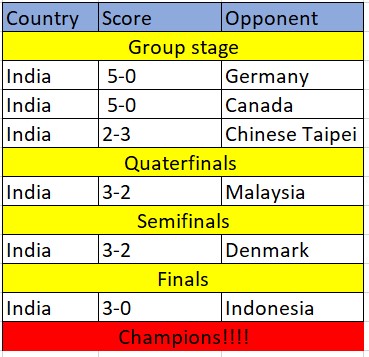
India was placed in Group C with Chinese Tapei, Germany, and Canada. They entered the quarterfinals finishing second after Chinese Taipei in the group stage. Through the next stages, they played with nations of greater pedigree- Malaysia and Denmark. Many would have expected a strong fight from India but not one which would lead them to the finals. However, taking everyone by shock, the Indian men sailed smoothly through these challenges of Malaysia and Denmark to reach their first-ever final at the Thomas Cup.
They were to face the 14 times champions, Indonesia in the finals. Successive wins by Lakshya Sen, Satwik Sairaj/Chirag Shetty, and the decider by Srikanth Kidambi helped India clinch their maiden Thomas Cup title. It’s an accomplishment that will never be forgotten.
Why is this Thomas Cup victory special?
Indian badminton is primarily a testament to individual success in the World Championships, All England, and the Olympics. The Indian men have been under the radar but lately, there have been signs of resurgence with the likes of Srikanth winning a World Championship medal, Satwik Sairaj, and Chirag Shetty’s emergence in doubles, and so on. Winning the Thomas Cup was a stepping stone for all the Indian men’s badminton players. Mental strength is equally important as physical strength and the men’s team showed immense of it at the Thomas Cup.
Believe in yourselves! We have heard it several times but only when we actually feel it, we can achieve what we want. That’s what the Indian men’s team taught us. Self-belief, resilience, confidence, and character were some of the major takeaways. They were facing 14-time finalists but once did they let that thought affect their game. I feel this is a wake-up call to all young players of the country that Indian badminton is on the rise and it should continue rising.
With increasing government and private support, badminton has excelled over the past decade in terms of academies coaches, and technology. Moreover, the recent performances have also attracted attention from several stakeholders in the sports industry. Surely, the Thomas Cup is a wake-up call to all players, government, and private entities that badminton has become one of the strongest sport in the country.
Best Men’s Singles Badminton Players of all time
In 1992, badminton was included in the Olympic Games consisting of five events: men’s and women’s singles, men’s and women’s doubles, and mixed doubles. Many of the players who have played in the past and present have been exceptional, and a sport of this stature is sure to have several standout athletes. Listed below are the top Men’s Singles Badminton Players of all time.
Table of Contents
#8 Morten Frost Hansen
Morten Frost, also known as “Badminton’s First Millionaire,” dominated European and world badminton from 1976 to 1991, spending twelve years among the top three players in the globe. He was a spectacular athlete with fluid footwork; his game was a hybrid of traditional singles with clears (lobs) and drops, with smashes usually reserved for weak returns. In 1998, he was inducted into the BWF Badminton Hall of Fame for his outstanding performance in the 1980s, which included back-to-back European gold medals in 1984 and 1986, as well as two silver medals at the World Championships in 1985 and 1987. He had a good run at the 1985 and 1987 Olympics, winning two Silver medals in the process.
#7 Peter Gade
Peter Gade topped the World ranking table for four years in a row from 1998 to 2001. Gade’s five European Championships titles in the men’s singles event and his All-England Open Badminton Championships singles championship in 1999 cemented his legacy in badminton history. Fast attacks, fluid footwork, and continual pressure are all hallmarks of his game.
#6 Son wan-ho
Son Wan-ho, a well-known athlete in the game, was praised for his defensive abilities and ability to remain calm in stressful situations and was acclaimed as the world’s number one in the Men’s Singles in May 2017. He has won the BWF World Championship, World Tour(Three Titles), and International challenge/series(one runner-up).
#5 Chen Long
Chen Long is a badminton player from China who was born on January 18, 1989. He is the 2016 Olympic winner, as well as a two-time World and Asian champion. Chen was a former World No. 1 who held the top spot in men’s singles for 76 weeks between December 2014 and June 2016. “Be yourself,” his philosophy, is certainly a mentor to many young badminton players. He has also won 18 gold, 9 silver, and 6 bronze medals at international competitions such as the World Championships, the 2012 London Olympic Games, the Sudirman Cup, the Thomas Cup, the Asian Games, the Asian Championships, the East Asian Games, the World Junior Championships, and the Asian Junior Championships.
#4 Kento Momota
Kento Momoto, a Japanese native, is widely recognized as one of the most talented players of this decade. His comfort on the court, distinct playing talents, and mastery of strokes and smashes surely earned him a spot on our list. He has been dominating the badminton globe for a while with his sublime methods, making it very tough for his opponents to get through with his strengths in his agility, skill, swift footwork, and brilliance in offense and defense.
Also read: Top 5 performances of Kento Momota
#3 Lee Chong Wei
Datuk Lee Chong Wei, who was born in Malaysia, is the only Malaysian badminton player to have held the World No. 1 ranking for more than a year, including a 199-week run from August 21, 2008, to June 12, 2012. In 2008, 2012, and 2016, he won three Olympic silver medals in the Men’s Singles event and dominated the Badminton Asia Championship in 2006 and 2014. Malacca Governor Moha Khalil Yaakob bestowed upon him the title of “Datuk Wira.”
#2 Lin Dan
When we talk about the most important player in badminton, the term “Lin Dan” is automatically mentioned. He is one of the best shuttlers in the history of badminton. He has earned the nickname “Super Dan”. His highest career record was 666 career wins, making him a two-time Olympic gold winner, five-time World Champion, and six-time All England Champion. Known for his aggressive style and top-notch defense, he was nearly unstoppable during his prime.
#1 Victor Axelsen
Axelsen is a vital figure and a backbone for the Danish squad, winning many gold medals at the European Men’s Team Championships. The Danish badminton player is the first singles player in BWF World Tour 1000 history to win all 1000 titles in a single season. He is recognized as one of Denmark’s most significant athletes, having won gold in both the 2020 Olympics and the World Championships.