
Badminton is an intensive and simple sport due to which people are quick to get into the sport but somehow make some mistakes while learning. The basic techniques in badminton should be developed correctly as they will define your game in the long run.
Badminton requires regular practice and a strong presence of mind to improve your game. As a beginner, you may come across several wrong techniques and mistakes in your practice. Beginners pick up many wrong badminton techniques, and habits that lead to errors and mistakes.
Some mistakes need to be corrected before going into the next game. So here are a few mistakes you should avoid to improve your game efficiently.
Wrong Grip
This is probably the most common mistake you will experience as a beginner. It is a mistake you need to avoid as how you hold your racket will determine the direction of the shuttle. However, most beginners avoid the correct technique and play with a grip they are comfortable with.
For instance, beginners use the panhandle grip for a forehand grip. The panhandle grip involves holding the grip like a pan, which is required to only play drive shots.
Another gripping mistake is holding the racket very tight which makes it difficult to change the grip quickly. It can also lead to wrist and tennis elbow injuries. Therefore, be careful with your gripping pattern.
The basic grips are forehand and backhand grips. So, whether you are a single or doubles player, you need to make sure that your gripping technique is correct. With practice, you can avoid all these gripping mistakes associated with your game. Moreover, the intensity of shots depends on the movement of your grip.
If you want to learn in detail about how to hold a racket properly and the different types of grips used in badminton, check out this article.
Incorrect Serve
A service fault is another common mistake you need to avoid. A service fault involves serving from the point above the permitted height which is 1m from the surface of the court. This leads to a fault which makes you lose points. It is applicable for both forehand and backhand serves but this error mostly happens with the backhand serve.
To get this right, an ample amount of service practice is required which would minimize the chances of losing points in competitive tournaments.
Check out this article if you want to learn more about the service rules in badminton.
Service Errors
Another serving mistake you should avoid is to not hit a loose serve which could make it easy for your opponent to hit a smash on you. If you are hitting a short serve, it should just be above the net and if you are hitting a high serve, it should be directed well back to the backcourt. These are the elements of a good short and high serve.
Serving too low might direct the shuttle in the middle of the net which would make you lose points. To overcome these issues, you need to practice regularly with the right technique.
Poor Reception Of A Serve
Another common mistake, you need to avoid as a beginner is executing a poor reception of a serve. Most of the beginners find it convenient to just clear the shuttle off their court while receiving a serve.
Well, only clearing the shuttle may cost you a lot. Moreover, your opponent will get an easy chance to execute smashes, which will deprive you of the opportunity to smash or trick your opponent.
Therefore, keep using different variations in your clears to confuse your opponent. It is better than hitting at one single spot. It is okay to make mistakes while trying variations as you will keep getting better at learning from them.
If you want to learn how to return a serve properly, check out this article.
Static Play
Whether you are playing singles/doubles, you always need to be on your feet so that it makes it easy to reach the next shot. In singles, you must return to your base position and not stand static at the place where you received the earlier shot. This will make it difficult for you to reach the next shot and you can be caught off balance by your opponent.
Conversely in doubles, when your partner is doing most of the work in a rally, you should not stand idle. Always be on your feet and wait for your chance at the rally. You should be able to adjust your court position with your partner whenever required.
Well, this comes with a lot of training and footwork practice.
Off-balance Smashes
You should hit a smash only when you are fully ready and have enough time to execute the smash. If you go for a kill while you are off-balance, then you are highly likely to miss it or you will be very vulnerable to counterattack.
So be patient and extend the rally and wait for the perfect opportunity to win. Even if you are losing, make your opponent work for every point. Well, this error is mostly made by professional players but as a beginner, practice hard and remember to not make such errors in the long run.
Lack Of Footwork
Footwork is the key element in singles as well as doubles. If you can start, stop, and change direction quickly according to the direction of the shuttle, you will be at an advantage as you will find the rest of the game easier.
One mistake every beginner should avoid is randomly moving around the court. This will make it very difficult for you to reach the shuttle at the right time. Use appropriate footwork to move around the court. It takes time to develop but it’s better than doing it the wrong way.
Practice a few shadow movements in your warm-up which means moving around the court imagining the shuttle at different corners of the court. Concentrate on your movement while doing this as it helps to increase the foot’s coordination. Trust me, your game will surely improve after incorporating footwork training in your everyday practice.
If you want to master the basic footwork in badminton, check out this article.
Proper Stance
A player should use a proper stance while serving and even while receiving a serve. Most of the time, people who start playing badminton, stand in a position they are comfortable with. Well, this habit is not good in the long run.
You must always stand with your non-racket leg forward and racket leg backward with your hands at chest level. This makes it easy to move for the next shot. Moreover, it shows your opponent that you are ready for the game. Standing loose puts a wrong impression on your game.
Frustration
As a beginner, there may be several instances in your practice where you may get irritated or frustrated and feel like quitting. Just like any other sport, it takes time and effort to develop your game in badminton.
It is often observed that players get frustrated when they make a mistake during a game. Well, there is no need to get discouraged in such situations because every player, even a professional tends to commit errors during a game.
Move on with the thinking that such mistakes will help you become a better player. Analyze your mistakes and practice hard to overcome them. Remember to keep trying as effective practice will surely give you your desired results.
Using The Wrong Equipment
Well, the equipment you use plays a very crucial role in your game. You should choose your equipment according to your expertise and level of play. For instance, a few beginners tend to use outdoor shoes on an indoor court. Well, this not only affects the quality of the court but also your gameplay.
So, therefore, purchase the right set of rackets and shoes according to your level of play and make sure that they match your skill level.
If you need some recommendations, check out this article, where we put together a list of the best badminton equipment out there.
Final Thoughts
It is quite normal for everyone to make mistakes but what matters is learning and moving forward from them. Repeating them will not do you any good.
If you are not getting the desired results, then don’t get disheartened. Normal ups and downs will come during your journey as a player and only focus and determination will help you move forward.
A perfect technique does not lead to a perfect game, you need to master the basics first and then proceed. Therefore, start focusing on the basics and then proceed to advance techniques.
If you need 10 great tips to improve your overall badminton game, check out this article.
I hope this article was helpful to you. Thanks for reading!
10 Great Tips to Improve Your Badminton Game
In a sport like badminton, certain techniques are very important to improve your game. Learning to play badminton in the right way is extremely essential to develop your game in the long run.
It is important to be flexible with your training as well as your game plan.
You need to work on your speed, focus, and technique, all at the same time for overall development.
In this article, I have enlisted certain principles that will help you improve your game. Read them and try to incorporate them into your regular practice.
Movement
It is very crucial to develop good movement as it will make you faster on the court. Good movement skills will reduce the stress on your body in the long run, which will save your energy in matches. While practicing, ensure that you combine all different types of movements for the overall development of your game.
The main different movements you can practice are Running/Sprinting, Lunging, Starting, and Stopping. All these movements will enhance your stamina and agility which will help you cover the court without getting tired.
There are various drills you can practice to enhance your movements. For example, A running drill where you run and stop as and when your coach blows the whistle or you start side running or some other form of movement.
Keep practicing such drills to see the change in your movements. There are many agility drills that you can practice with the help of your coach. Adapt to such changes and have an open mind to be flexible to use different types of movements in your training.
Footwork
To play badminton, you need to reach the shuttle to receive it. Moreover, you need to move efficiently with proper footwork. Footwork is the most important principle in badminton and the most difficult to master.
There are many drills with which you can improve your footwork. Make sure to do some footwork practice in your warm-up every day. Effective footwork helps you to get into position and execute a shot properly.
Effective footwork helps you cover the court effortlessly and enhances the coordination of your legs with the other part of the body. Well, you should also strengthen the important muscles through effective exercises that will improve your performance even more.
In professional matches, you might have observed players playing long and exhausting rallies. Well, one of the reasons they can play those rallies is that they have strong footwork to cover the court and reach every shot. It takes hours of rigorous practice and dedication to improving your footwork but the results are fruitful.
If you want to learn more about footwork, check out this article.
Hand-Eye Coordination
Considering you can reach the shuttle, the next step is to hit the shuttle at the right place and the right time. Most players make mistakes while hitting the shuttle either by missing the shuttle or hitting it in the wrong way. The best way to avoid such mistakes is to improve your hand-eye coordination.
There are different ways through which you can improve your hand-eye coordination. You can play other fast sports like Table Tennis and also train your brain to think fast while in court. Occasional table tennis, football, and catching practice are effective mechanisms to enhance hand-eye coordination.
Grip
Do you know that a badminton racket has a sweet spot? What is a sweet spot?
A sweet spot is a point on the racket from where you can hit the shuttle with maximum power without using much energy. Well, all badminton players must know the sweet spot of their racket to receive the shuttle properly.
For this, you need to use proper gripping techniques like the forehand and backhand. Once you learn these grips, you should practice shots with the grip, and then you will get to know how to hit the shot properly. Inappropriate gripping patterns can lead to injuries and poor performance.
If you don’t know much about the various grips in badminton, don’t worry. Check out this article, where I have talked about everything you need with pictures.
Recovery
One of the most important aspects to improve your game is how fast you can recover to your base position and be ready for the next shot. It gets really difficult to reach the shuttle if you have not taken your base position. Attempting shots from the base position make it easier to reach the shuttle.
Well, footwork plays a key role here. You need to practice rigorously to return to the base position after every shot.
Stances
There are different stances in badminton you need to master to improve your game. You need to understand when and how to move into these stances. The most important ones are:
Defensive Stance: You must move into this stance when you have lifted or cleared the shuttle high giving your opponent a chance to attack. You must be ready to defend the shuttle whatsoever standing with feet wide apart and slightly bending your body to receive the shuttle.
Attacking Stance: You must move into an attacking stance whenever your opponent delivers the shuttle at your backcourt. There are different ways to land in an attacking stance either landing on your right foot and hitting it sideways or receiving it backhand.
Forward attacking: Well, this is one important stance you need to practice to attack the shuttle close to the net when it is slightly above the net. It involves jumping from the middle of the court to directly hit the shuttle at the net and landing on your racket’s side leg.
Lunging: For every movement in badminton, lunging is very important. To receive the shuttle sideways and forward, your movement mostly ends with a lunge. Practice this stance to reach the shuttle faster by stretching the capacity of your lunge.
You need to anticipate well in advance about which stance you need to move into.
Additional Physical Activities
You can practice additional physical movements to improve your hold and wrist power by using a heavy badminton racket or a squash racket to hit different shots. To improve your running technique, there are many agility drills, shadow practice drills you can do with the help of your coach. These exercises will help to enhance your movement, lunges, and overall game.
Strength training and core training are also very important to improve your balance and muscle strength in badminton.
Play With A Variety Of Players
If you keep playing with the same level of players time and again, your game will remain stagnant. To effectively improve your game, it is important to play different types of matches with different types of players. For instance, if you are a right-handed player, you can practice one match by playing with a left-handed player and vice versa. When you play like this, you get to understand their techniques and style of play.
Also, practice other sports such as cycling, running, and swimming for the overall development of your body movements.
Observation
The best way to learn some movement or shot is to observe a player doing it and practice in the same manner immediately. When you watch badminton matches or videos, observe the movements, and try to incorporate them into your practice. Observation is really important for your body because when you watch a video of a shot, from every angle, it gets easier to memorize and try it.
Change Is Inevitable
You need to adopt changes in your training as well as during a match to adapt to your opponent and playing conditions. If the opponent can predict your game, you will be at a disadvantage in the game so therefore, change it immediately. You have to keep changing your game plan as it will prevent your opponent from guessing your strategy.
Final Thoughts
To steadily improve your game, mix practice, theory, videos, and training sessions whenever possible. As you can see, there are several ways to improve your game so keep practicing and never lose hope.
Moreover, all these principles can be practiced more effectively with the help of an efficient Coach. Practice a few extra activities and exercises o steadily improve your game. Play with different types of opponents under different conditions for overall development.
Most importantly, track your progress and keep a training diary to analyze your strengths and weaknesses. Try to make the most of what your coach instructs you.
I hope this article was helpful to you. Thanks for reading!
How to Practice Badminton at Home
Amidst the COVID-19 pandemic, every badminton player might be afraid of the consequence of the lack of effective practice in their game. Many of you may have observed a decline in your performance and fitness due to the pandemic.
I am sure you might hear of the saying, ‘Where there is a will, there is a way’. So don’t be disappointed as I will help you with key exercises to practice at home to not lose touch with your game and be very much in form.
There are many ways you can practice badminton at home without a partner. So in this article, I have described various exercises that will help to improve your badminton skills as well as overall body movement.
Moreover, this will help you feel more confident once you get back to your normal routine. Here are some exercises or drills that you can practice in minimum space.
Wall Practice
Wall practice is one of the basic and most important drills in badminton which you can do at home as well. You just need a wall, your racket, and an old shuttle.
You can tape the wall as per the height of the badminton net(1.524m) and practice accordingly. Of course, the walls of your home may not be of great height so at home you can practice chest level shots also known as parallel shots. Remember to squat a bit and jump which your legs shoulder-width apart while receiving the shuttle.
Practice both ways, backhand, and forehand and this helps to efficiently improve your grip pattern. Parallel shots are more important for doubles players so practicing this at home will keep you quite in touch for your shots. Remember to control the strength so that you can maintain a rally with the wall.
Challenge yourself by aiming a rally of 100,500,1000 and more. There are many benefits of this drill as it improves your reflexes, wrist power, and coordination as well as speed in changing your grip.
Skipping
Badminton movement heavily depends on your toes and skipping is one of the best exercises to strengthen your toes and joints around your ankle. Beginners can start off by skipping with both legs and then can progress to skipping on one leg for better strengthening.
Try to do at least 1000-2000 skips or for 10-15 minutes and keep challenging yourself. Moreover, skipping is a great exercise for your cardiovascular system. So it will help to improve agility as well. Those facing problems with skipping can opt for a jog or a run on the treadmill.
Skipping rope also works up your calves and forearms which are equally important in badminton. While forearms help to execute better and stronger shots, calves bring out efficient movement on the court.
Advance players must focus on mastering double skips as this is a great exercise to improve your jump while smashing.
Physical Fitness And Training
Badminton is the fastest sport in the world and physical fitness is of utmost importance. The Lockdown phase and staying at home may be challenging as it restricts movement and activeness which can lead to weight gain and losing muscle strength.
Badminton requires everything from speed, agility, strength, and power. So, to focus on every aspect, it’s better to plan your training to focus on each parameter for better results. Consult with your coach or fitness trainer while planning for the same.
There are many exercise patterns that you can add to your practice.
Agility Exercises
Agility helps to sustain long and intense matches and plays a key role in a player’s performance. One of the main reasons that Asian players dominate the badminton world is that they possess good agility in their bodies. There are many exercises that you can practice to improve agility that can be easily performed at home.
Remember to jog every day for at least 10 minutes and also mix it up with skipping for 10-15 minutes or 1000-2000 skips regularly as these are great for your cardiovascular system.
- High Knees
- Moving legs back and forth, side and inside, and criss-cross.
- Kangaroo jumps
- High jumps (you can mix it with two low jumps and then a high jump)
- Lunges (moving/stationary depending on your comfort)
- Sprinting- This can be done stationary standing at one place or if you have someplace in your hall/veranda you can utilize that space to sprint for 2-3 rounds.
Shadows
Shadow practice is one of the most important elements in badminton. Importantly, it is done without the need for another player, shuttle, and court. There are various variations that you can add to your shadow practice but remember to practice it at least once a week. Moreover, visualize each shot when you are practicing shadows.
This helps to improve, coordination, speed, movement, and balance on the court. When you watch players like Tai Tzu Ying, Kento Momota, you must have observed their amazing footwork pattern which helps them to cover the court fast as well as efficiently.
As you are at home, you can practice shadows on your terrace or your lawn. Remember to focus on your speed and technique and try to increase your speed eventually. In addition to this, don’t practice shadows on a hard or rough surface as it can affect your knees.
Racket Swing Practice
Well, this is specifically to keep your arms under motion while at home. The racket swing practice is practiced stationery where you just move your hands and arms with your racket imagining yourself hitting a particular shot.
This is very effective for practicing smashes, clears, and backhand shots, defense, and many more as it helps to improve your gripping pattern and arm strength. To make it more challenging try to use a heavier racket or a tennis racket for added benefits.
Circuit Training
Badminton is a very intensive sport that demands overall body fitness. Circuit training helps for weight loss, agility, stamina, and overall physical strength. There are many exercises that you can incorporate into your circuit training.
You can perform each exercise for 30-50 sec and move on to the next. However, remember to practice exercises that will focus on each area of your body like core strength, arm strength, and leg strength.
Core Training
Core strength is very important in any sport as it helps to improve balance and stability. Dedicate a part of your training once a week to developing your core strength.
There are numerous exercises that you can practice to develop your core, for eg, crunches, planks, mountain climbers, and many more. All these exercises can be easily performed on a yoga mat. Keep challenging yourself to feel the burn.
Shuttle Training
On the court, this training is usually done on all six corners of the court. However, at home, you can focus on one area each by placing 5 shuttles on a particular area and 1 shuttle in the middle.
By using proper footwork, you need to pick up all five shuttles one by one and place them in the middle by moving to and fro from the middle. You can practice this for 3-5 sets on each side.
Final Thoughts
Everybody is different and can handle different levels of stress. So please remember to understand your body and figure out how much stress can it handle so that you don’t overexert yourself as this could lead to injuries. Patience is the key to success so be patient to see your results as it takes time for your body to accept and show changes.
Your performance in every type of sport heavily depends on your physical fitness as much on your skills. Therefore, devote your time to improving your overall body fitness as this will improve your game even more.
Developing your skills and improving fitness can be done anywhere so don’t be disappointed and keep practicing on your own. Please remember to consult your coach or trainer before you start your home fitness program.
Badminton Trick Shots: A Comprehensive Guide
Trick shots in badminton are used to trick your opponent. They help to confuse your opponent under pressure situations and serve as an advantage for you if executed properly. It can easily help you to win a rally.
Many trick shots have been used over the years by elite players like Lin Dan, Tai Tzu Ying, and many more which have inspired other players to learn those shots. However, these trick shots come up with practice and experience.
In this article, I have explained a few trick shots which will be helpful in your game in both singles and doubles. So, read about all of them and try using them in your everyday practice sessions.
Badminton Trick Shots
Check out the following video to watch how to play all the trick shots. Then, read the article to learn more about these shots.
Lin Dan Baseline Trick
This trick is inspired by the badminton legend, Lin Dan. In this, you have to run towards the backcourt and hit the shuttle just before it touches the ground by rotating your forehand and body while hitting.
Remember, you will not be facing the net while hitting the shuttle. You have to hit the shuttle pretty hard so that it travels over the net to the opponent’s court.
This is a trick shot because your opponent will either feel that you won’t be able to hit the shuttle or won’t be able to predict where the shuttle would land. Moreover, he/she would reach the shuttle a little late. While hitting the shuttle, bend your wrist to make the shuttle go crosscourt.
Cross Net between Legs
This trick shot is like moving for a normal net shot towards the net with a lunge but hitting the shuttle from between your legs. You make a double-action, first pretending to hit the shuttle like a normal net shot, which confuses your opponent as he/she will be prepared for a normal net shot.
At the very next moment, before the shuttle touches the court’s surface, you step in front of the shuttle and aim for a cross net shot between your legs. You need to be quick enough to step in front of the shuttle and hit the shuttle with a small push in the fingers grip.
Peter Gade Signature Shot
As the name suggests, this trick shot is inspired by the living legend, Peter Gade. It is used when the opponent aims a backhand net shot at you. The trick here is that you pretend a backhand net shot action to confuse your opponent, and in the next moment you hit the shuttle aiming for a cross-court net shot with the racquet head pointing downwards.
For this, you have to rotate your forearm from the outside of the shuttle. Again, your action needs to be fast so that it can be done before the shuttle reaches the ground.
Double Defence Tricks
This trick is used when you are being attacked with smashes. In your first defense, you can hit the shuttle in the normal way. However, to confuse your opponent when he/she smashes again, you can defend the shuttle by hitting it behind the back and between the legs. A small jump while hitting it makes it better.
This trick shot is just to have fun and use small strokes and your fingers to generate power. It can also be hit from behind your back and the side of your body.
Tennis Top Spin Backhand
This trick shot is used when the shuttle reaches your backhand midcourt area at a slightly greater height. The trick here is that you hit the shuttle to the crosscourt area of your opponent.
This is done using the thumb grip which helps you to get a swing from down to get a spin. You then rotate the forearm and swing over with big topspin.
This will trick your opponent as he/she will not be prepared for the return. This shot requires a full rotation of the forearm as well as your shoulder.
Return with the Grip
This shot is similar to hitting a normal net shot very close to the net. However, the only difference is that instead of the shuttle being hit with your racquet, it is hit with the grip of your racquet. This allows the shuttle to fall very close to your opponent’s net, sometimes making it difficult to return.
The trick here is that while your opponent thinks you will hit the shuttle with the racquet, your trick it by playing with your grip, which your opponent is unprepared for. Make it look like a normal return and bend the racquet backward, hitting the shuttle with the bottom of your grip.
Cut with the wrong strings/ Slice Return
Use this trick shot when you receive the shuttle at the backend of the court. Make it look like a normal shot and then slice it using the wrong strings of your racquet. This return will go as a surprise to your opponent as he/she would not be prepared for it.
A slice return confers a spinning movement to the shuttle using the thumb grip. It also changes the angle of return to the opponent. In this, the racquet head is angled inwards or outwards depending on your position at the last moment of hitting the shuttle.
So even though the racquet head seems to make a forward motion to the eyes of the opponent, it travels cross court. Importantly, a slice return makes the shuttle travel in a curvilinear path which makes it difficult for your opponent to face it or to return it. Remember to hit the shuttle high and in front of your body.
Sukamuljo Spin Serve
This service is inspired by the doubles legend, Kevin Sikamulji. You have to hit the edge of the shuttle without touching the feathers as it would consider a fault.
Instead of hitting the shuttle straight, you have to change the angle a little bit towards your body so that you can hit from the edge of the shuttle. Secondly, do not hit straight with the racquet. Hit in the opposite direction, i.e. hit away from the direction you want to serve, which will produce the spin.
This makes it tricky for the opponent to return. Also, allow the racquet to go a little bit under the shuttle on impact. A perfect serve will have the feathers going over the net first.
Forehand Crazy-Cross
You can use this trick shot when you receive the shuttle at the forehand net corner of the court. While return, start with a normal forehand grip and position.
Immediately rotate the forearm outwards so that it can bend properly. Then hit the shuttle from the outside so that it crosses the net on the other side of the court. This shot will come as a surprise to your opponent.
Magic Spin Serve
This is a forehand serve trick. In this, hit the shuttle on the side with a downward curved swing. This will spin the shuttle and it will be difficult to return for your opponent. This is one of the easiest and commonly used trick shots.
Fake Smash
This trick is predominantly used in men’s singles. Here, you pretend to clear the shuttle with a jump smash. This will picture a smash in your opponent’s mind. However, instead of hitting a smash, you hit a straight or cross-court drop.
As a result, your opponent will think of the shuttle coming as a smash but a drop will come as a surprise. Either your opponent will reach the shuttle late, or sometimes might be not able to return it.
Check out the following video to see it in action.
Final Thoughts
All trick shots look very amusing but they require a lot of practice and confidence to do it correctly. So, therefore, keep practicing and push your limit every day.
Also, you might have heard of doing things correctly at the right time. Well, you need to execute a trick shot at the right opportunity to take maximum advantage of it.
I hope these tricks will help you to keep up your game in your favor. If this article was helpful, do share it so that others can find it as well.
If you want to improve your game by practicing badminton drills, check out this article.
Thanks for reading. Enjoy the game!
Badminton Net Play: The Complete Guide
Badminton net play is a really important skill that you should master to dominate your opponents at the front-court area. Net play is the term that is commonly used in badminton to describe the play near the net or front-court.
Even though there isn’t any particular way to master the net play, you need to learn the basics shots and the right technique to become good at it.
No worries! In this article, I’ll walk you through the basics of net play in badminton. Let’s dive right in.
Footwork and Racket Control
If you want to play the net shots perfectly, the first and foremost thing that you need to improve is your technique, especially footwork. You need to have solid footwork to dominate the front-court.
If you don’t know anything about footwork in badminton, I suggest you check out this article I’ve written on the topic Basic Footwork In Badminton. Anyways, let’s look at the footwork that you should have near the front-court area to play the net shots.
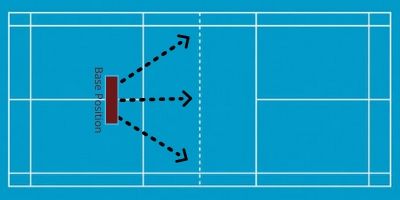
The footwork is based on the base position, which is the center of your court. That is where you take the initial stance. When you take the stance, hold your racket above the level of your belly. Do not hold it downwards. Also, your non-racket arm should be placed out of the way on your side. This is the ready position for net play.
The advantage of this ready position is that it will give you room to the shot without getting jammed to your body with your racket. If you keep your arms and racket close to your body, you’ll get stuck if the shuttlecock comes to your body.
By keeping your racket out in front of you and your non-racket arm on the side, you’ll be able to hit the shots that come at you, and you’ll be a bit closer to moving to the shuttle if it is placed near the net.
When you move to the net area from the base position to hit the shuttle, your racket needs to move first towards the shuttle rather than your feet. After you finish hitting the shot near the net, you shouldn’t drop the racket down.
In match situations, when you finish the net shots, you need to keep your racket steady and upwards. That will make sure that you’re ready for the next move as soon as possible.
It will also help you maintain your upper body balance, which is pretty important in recovering back to your base position to get ready for the next shot.
Basics Of Net Play In Badminton
Net play in badminton is often really quick, and you might have to make quick decisions in your mind. When you play near the net area of the court, always try to hit the shuttlecock at its highest point in the air.
When the shuttle is up above the level of the net, that’s when you should definitely hit it. Don’t wait for even a second. If you’re late to hit the shot, it will end up on the net, and you’ll lose the point. If you can’t hit the shuttle when it is high, then you might have to lift it upwards, which will give the opponent a chance to attack you.
So be quick to reach the shuttle and hit it when it is at the highest point. If it is up there to hit, just hit a smash and kill the rally.
Also, it is important to learn how to adjust the power of your shots to place the shuttle in the area where you want it to land. You’ll get better at it as you practice and play more.
We use badminton net play mainly to force the opponent to lift the shuttlecock up in the air so that we will get enough time and space to hit an attacking shot to end the rally.
Types Of Net Shots In Badminton
Now, let’s look at the basic net shots played in badminton and learn how to implement them.
Tumbling Net Shot
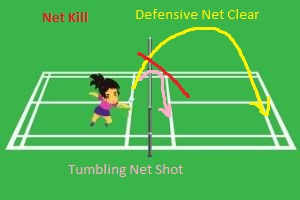
The tumbling net shot or the spinning net shot is one of the important shots in net play. If you can hit a proper tumbling net shot, the opponent either won’t be able to take it, or he/she will be forced to lift the shuttle up in the air. That will give you the chance to hit a smash and kill the rally. So, this is a very good weapon to get points and this shot itself can be a killer shot.
A normal net shot will travel without spin, whereas a tumbling net shot will have a spinning effect on it. This spin effect can make it really hard for the opponent to pick it.
You can provide a spin to the shot if you hit the shuttle at an angle so that the contact point of the shuttlecock is both the feathers and the cork. When you hit only the cork base, the shuttle will travel without the spin. Try to practice hitting the shuttle on both the cork and the feathers at the same time.
Net Kill
The net kill is used to end the rally if the opponent poorly hits the shuttle in the air around the net area. This is one of the easiest shots, if not the easiest, to win a point. This is similar to a smash, but the shot is much quicker and closer to the net.
Net Lift
The net lift or net clear is a defensive shot that can be used when your opponent hits a pretty good net shot to your court. If your opponent is great in playing net shots, then you can hit this shot aiming at the baseline to avoid the net kill.
The net lift or net clear is pretty similar to the normal defensive clear shot. The only difference is that it is played closer to the net.
Cross Net Shot
Apart from these three shots, you can also play the cross net shot. This shot can be deceptive and pretty hard for your opponent to pick if executed correctly.
The cross net shot is similar to the normal net shot, but the shuttle is hit diagonally to the opposite side of the court. This diagonal hitting can be done by rotating your arms and wrists.
To learn this shot properly, take a look at the following video and practice it many times. You can dominate the net area with this shot.
If you want to learn some drills to practice various net shots, then I would urge you to check out this article from the badminton coach Andy. It will be really helpful.
Final Thoughts
We’ve covered the basics of net play in badminton. Apart from these basic shots, there are a lot of other net shots. You can see several top badminton players play different deceptive shots at the front court. If you want to check out some of them, read the article on Badminton Trick Shots.
I hope this article was helpful to you in understanding the fundamentals of badminton net play. If it was useful, do share it so that others can also find it.
Thanks for reading. Enjoy the game!
Feather Shuttlecock vs Nylon Shuttlecock
As you may already know, In badminton, we generally have two types of shuttlecocks: feather shuttlecocks and nylon shuttlecocks. Even though both look somewhat similar, they have a lot of differences when it comes to the different aspects of the game.
In this article, I’ll help you to learn the differences between both of these shuttlecocks. Hopefully, you’ll be able to select the right shuttlecock, which is appropriate for you according to your needs.
With no more fluffy introduction, let’s dive right into the main content.
Differences Between Feather & Nylon Shuttlecocks
There are several differences between both of these types of shuttlecocks (we also call them birdies). Both of these types have advantages as well as disadvantages when we compare them head to head.
Let’s look at the differences between these based on different aspects such as material, speed, weight, accuracy, price, durability, etc.
Material
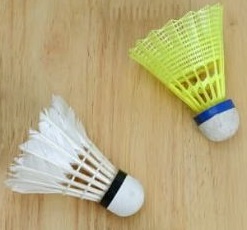
Nylon shuttlecocks are made of nylon/plastic material, whereas feather shuttlecocks are made of feathers from birds, namely, duck or geese.
The feather shuttlecocks have a total of 16 feathers attached to a solid cock base. All the feathers have the same weight. Two layers of stitching are used to tie these feathers together. The feathers are glued to the cock base.
There are also some differences between goose feather shuttlecocks and duck feather shuttlecocks. Goose feathers have thicker bristles compared to duck feathers. And hence, the former has better durability and slightly more accuracy.
The upper part of the nylon shuttlecock is not a combination of different pieces. It is just a single piece. However, the nylon shuttlecocks have 16 markings or arcs similar to the feather shuttlecocks. The design of the nylon birdies is made in such a way that it looks very similar to feather birdies.
The cock base in both feather and nylon shuttles are almost the same, except that the cock base of the nylon shuttlecock has a little more weight compared to the other one. However, when it comes to the upper part of the shuttlecock, the feather part has a little more weight than the plastic part.
Weight
For a feather shuttlecock, the distribution of weight is almost 40-60 between the upper part and the base, whereas it is almost 20-80 for a nylon shuttlecock.
The heavy cock base of the nylon shuttlecock isn’t good when it comes to the quality of the shots. However, this can be helpful when we play the game outdoors. This weight distribution helps to play the game even if we have a slight breeze. But for indoor games and professional games, feather birdies are better.
Accuracy
Due to the difference in weight distribution, the feather shuttlecocks have better accuracy compared to nylon shuttlecocks. This can be really helpful for a player who can play accurate trick shots and net pay.
This accuracy difference doesn’t matter that much when you play the game for fun with your friends or when you play practice matches. But this does make a huge difference when it comes to professional badminton. That’s why the feather shuttlecocks are preferred for professional matches.
Also, the nylon shuttlecocks tend to wobble more compared to the feather shuttlecocks, especially for net shots. But feather shuttlecocks are ideal for playing net shots.
The two different types of feather shuttlecocks also have accuracy differences. Feather shuttlecocks made up of goose feathers are more accurate than those made up of duck feathers.
Speed
Since the feather shuttles are more accurate having a better weight distribution, the speed of these is less than that of the nylon birdies. Due to the rigid structure of the feather shuttlecocks, they have a higher declaration compared to the nylon shuttlecocks.
Nylon shuttles tend to deform more than feather shuttles when we hit them. The initial speed of the feather shuttles will be high. However, it decelerates faster because of the higher drag it experiences during its flight. Due to this, it will travel less distance and fall to the ground at a steeper angle.
The feather birdie goes more upwards when we hit, whereas the nylon birdies travel at a much more flat angle and go more distance.
Due to the flat trajectory of the nylon shuttles, it is comparatively difficult to hit the jump smash with a nylon shuttle. Controlling the shuttle is difficult for nylon shuttles, and it requires more power to hit the shuttle.
You can adjust the speed of a feather shuttlecock by tipping the shuttle, which you can’t do with the nylon shuttlecocks. The feathers can be adjusted to make the shuttle faster or slower. However, it is not legal to do that when you’re playing a game.
Durability
If you ask me which type of shuttlecock is more durable, I can easily answer you that it is the nylon shuttlecocks. Nylon shuttlecocks are way more durable than feather shuttlecocks due to the nylon material.
Feather shuttlecocks get damaged easily with 2-3 games, whereas nylon shuttlecocks can last up to 6-7 games on average. Obviously, it depends on how powerful the shots we play are. But, generally, nylon shuttlecocks can last many more shots than feather shuttles.
This is why nylon shuttlecocks are preferred over feather shuttlecocks when we play badminton for fun. So, for practice games and enjoyment, go for nylon shuttlecocks. If you’re considering playing badminton seriously, maybe on a professional level, then play using feather shuttlecocks.
Price
When it comes to pricing, feather shuttlecocks are generally more expensive than nylon shuttlecocks. So, if you’re a beginner-level player, or want to play the game for fun, choose nylon shuttlecocks as it is less expensive and more durable.
Feather shuttlecocks are expensive and less durable. You have to take proper care of the shuttles while playing if you want it to survive for as many games as possible. Replacing the feather shuttlecocks often becomes inconvenient.
So, the bottom line is that use nylon shuttlecocks for playing casual games with friends or practice games. Go for feather shuttlecocks if you’re playing professional badminton.
Best Nylon Shuttlecocks
If you’re playing badminton casually, you can choose the Yonex Mavis series, which is the best nylon shuttlecocks available on the market now. For more durability and less price, you can choose the Yonex Mavis 2000 nylon shuttlecocks.
Click the image to check out this product on Amazon and see the current price:

Best Feather Shuttlecocks
The best feather shuttlecocks available for professional games are the Yonex Aerosensa Series. The Aerosensa 40 feather shuttlecocks are pretty accurate and powerful. These are made up of goose feathers with 100% solid cork.
These shuttlecocks are preferred for several international competitions due to their high accuracy and stability.
Click on the following image to check the current price on Amazon:

Final Thoughts
As you’ve seen, there are a lot of differences between nylon and feather shuttlecocks. I hope this article has helped you in learning the differences between both of them. Ultimately, you have to choose the right one for you according to your needs.
If you’re looking for other badminton equipment, then you must check out the article I’ve written about the best badminton equipment. It will help you choose the right products for your game.
I would appreciate it if you’d be willing to share this article if it was helpful to you.
Thanks for reading. Enjoy the game!