
In badminton, a service is the most crucial shot to start a rally. However, badminton has several rules concerning a service that are meant to limit the advantage of a serve.
In one of the previous posts, you will come across the different types of serves in badminton. The first step in learning a badminton serve is understanding the badminton service rules.
The rules place limitations on the way you serve, and service faults will lose you points. Service rules are different in singles and doubles. However, certain general rules are to be followed in both. This full guide will help you in understanding everything about service rules.
Let’s dive right in and learn the basic service rules in the game of badminton.
General Service Rules in Badminton
In badminton, singles and doubles follow a different pattern of services and there are a few rules that differ between them. However, I have enlisted a set of general rules that are to be followed in singles as well as doubles.
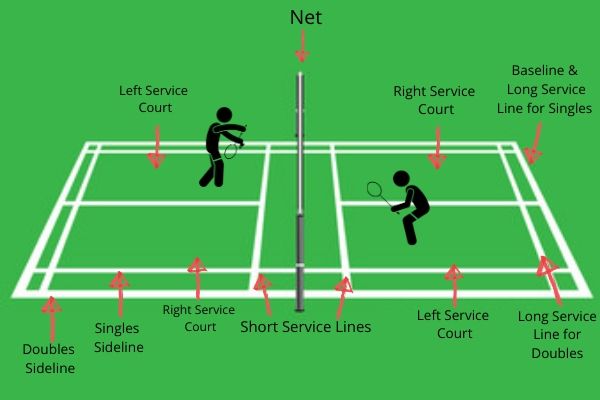
- The first and foremost rule is that you must always serve cross-court to your opponent. This means that you have to serve diagonally. The server and receiver must be in their respective diagonal courts. Notably, a service must be directed to and from diagonal courts.
- You cannot serve the shuttle unless your opponent is ready.
- The server and receiver must stand stationary on the court and cannot move until the shuttle has been served.
- You must not touch the boundary lines of the respective court. This is considered as a fault. However, if your service lands on the receiver’s boundary line, it is considered to be in.
- For love(zero) and even number scores, you serve from the right court. And when the score is odd, you serve from the left court. So every time you score a point, you have to change your service position depending on the score.
- The shuttle must be 1.15m above the court’s surface at the instant of being served. Anything above that is considered a fault. This can be a problem for tall players, but putting a standard height will reduce the arguments with the service judge for a service fault.
- From hitting the base of the shuttle, your service must be in one continuous motion.
- The serve has to be over the net and land on your opponent’s court beyond the service line. It is okay if it touches the top of the net.
Also read: Badminton Rules: An exquisite guide
Service Rules in Badminton Singles
Always remember, the valid service court in singles is long and thin. It is made up of four lines- The centerline, the singles sideline(inside sideline), the front service line, the backline( the outside backline).
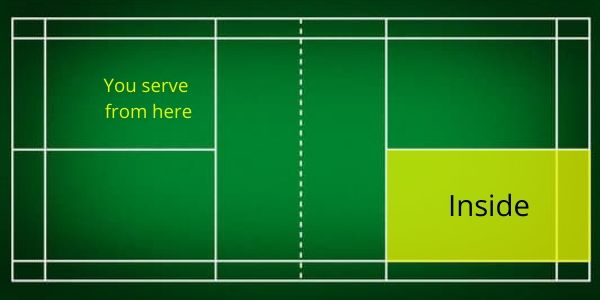
If the service lands beyond these lines, it is considered as a fault.
The decision on who serves first is straightforward in singles. A coin is tossed and if you win the toss you can either choose either the service or court. The side winning the toss has the option of serving first, not serving first, or choosing sides.
Service Rules in Badminton Doubles
In doubles, the service court is wide and short. It consists of- The centreline, the doubles sideline (outside sideline), the front service line, and the inside backline (just before the outside backline).
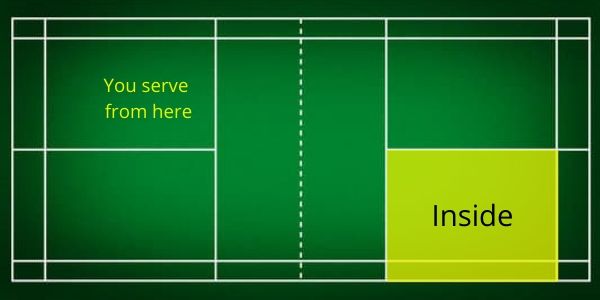
It is considered a service fault if your service lands beyond these lines. While you serve, either from the right side or left side (depending on the score), your partner can stand anywhere on the court as long as he/she does not interfere with the service. Usually, the other player stands in the middle at the back of the court.
The most confusing rule for many is the change of place rule in doubles.
Here is a small explanation that will help you understand this rule.
When you win a point, you change your place with your partner to serve from the alternate left/right service court. While you change your place, your opponents will remain in the same service court while you serve.
The decision of who will serve in doubles is decided again with a toss of a coin. First, it is decided which team will serve first and then who will stand on the right and left service court. The service is always started from the right-hand service court so therefore, the person who decided to stand on that side will serve first.
Once the first rally is over, there are two possible scenarios.
- The server’s team could win the rally. In this case, the server’s team will gain a point and retain the serve. The person that serves rotates to the other side of the court to serve for the next rally.
- The receiver’s team could win the rally. They gain a point and win the serve. While serving, two things that need to be considered. The first being, what was their respective service court in the previous rally? Followed by, whats their score? If it is an even score, then the person standing on the right court will serve, and if an odd score, then the person standing on the left court will serve.
You must not change your court until you win a point and no player can receive two consecutive serves. Please remember that if a player has served or received out of turn, or has served or received from the wrong service court, then it is considered a service error, and not a fault.
Service Faults
Whenever a service fault is called, you lose a point and your opponent is awarded the rally. Most commonly it happens during a low serve. Here are the common service faults that you can come across.
- The first common fault takes place when the shuttle does not land on the correct service court of the opponent.
- The server’s/receiver’s feet are not stationary on the court. While serving or receiving, you cannot move your feet away from anywhere you are standing.
- You step forward while you serve.
- When the shuttle is hit twice in succession by a player. For instance, in doubles, if the shuttle touches the racquet or body of one particular player, it cant be hit by the partner to continue the rally.
- When your opponent attacks the net before the shuttle is served. This point goes in your favor.
- The shuttle, at the instant of being served, is higher than your waist or the head of the racquet is higher than the servers racquet hand.
- Any unnecessary delay in service can also be declared as a fault by the referee.
Therefore, when you are delivering a service, be aware of these fouls and try to avoid them.
Service Lets
A let is called by an umpire to halt play. The rally is stopped and replayed without changing the score or serving positions. There are various instances when a service let can occur. When a let occurs, the last service does not count and the player who serves has to serve again.
Here are a few scenarios in which the umpire calls a service let:
- You serve before your receiver is ready. However, if the receiver attempts the serve, he/she is considered to be ready.
- While servicing, the shuttle passes the net but get stuck on the net from the top. However, if the shuttle passes through the net, it is considered out of play.
- During play, the shuttle breaks off and the base completely separates from the rest of the shuttle.
FAQs
Who serves first in Badminton?
The first player/team to serve first in a badminton match is decided by a coin toss which is conducted by the umpire. The winner of the coin toss can choose between the two-
- To serve/receive first
- The Courtside
Further, if the winner chooses to serve first, the opponent player/team can choose the courtside from where they want to play.
However, if the winner chooses the side of the court, the opponent has to serve first. In doubles, any of the two players on the serving team can serve first. Likewise, any of the two players of the receiving end can receive first.
Which Side of the Court should you Serve From?
You should always serve from the right side of the court when you have an even number of points (for example, 0,2,4,6…). Conversely, you have to serve from the left side of the court when you have an odd number of points (for example, 1,3,5..). This is applicable for both singles and doubles.
Who serves first in the 2nd and 3rd games in Badminton?
In singles, the player/team who wins the first game serves first in the second game. In doubles, any player of the winning team can choose any player to serve first, and likewise, the receiving team can choose any of the players to receive first.
In the same way, the player or team that wins the second game will serve first in the third game.
Is a service considered if it falls on the service boundary line?
Yes, if a service lands on the line of the service boundary, it is considered a correct service, and the server is given the point. Well, this rule is applicable for other shots as well after service. If a shot lands on the boundary lines, it is considered a correct shot.
Is Overhead Badminton Service allowed?
No, you cannot serve overhead in badminton. As per the BWF guidelines, the shaft and racket head should be pointing in a downward direction.
How many serves are allowed in badminton?
Unlike Tennis where a player gets two chances to execute a service, in badminton, a player can serve only once and will lose a point if he/she makes a fault.
Does a service count if it touches the net but still lands within the service boundaries?
Yes, it is considered a valid serve if a service touches the net slightly but still falls within the service boundaries. However, this happens very rarely.
When do you rotate service positions in doubles?
Doubles partners rotate their service positions from right to left court when they win a point that they served.
At what height can you hold a shuttlecock while serving?
The shuttlecock should be below 1.1m from the surface of the ground while serving.
What if the receiver is not ready?
If a receiver is not ready, it is considered a ‘let’ and the server serves again. However, the service will be considered if the receiver attempts to hit the shuttle.
Conclusion
You must make sure that you understand all the rules before playing a game of badminton. Remember, a service fault is a point gone. Lack of knowledge of the rules will affect your play as you may lose points due to service faults. This will in turn prove to be an advantage for your opponent.
Mastering the service rules is equally important as mastering the different types of serves. It will not only help you in reducing your service faults, but you will also be able to identify when your opponent makes a fault.
If you have read this whole article and understood the theoretical concepts of the service rules, now it is time for you to practice and avoid service faults.
To learn more about various shots and techniques in badminton, check out the other articles on this website. You can start by learning how to return various types of serves perfectly.
I hope this article was helpful. If so, do share it so that it will reach other badminton enthusiasts as well.
Thanks for reading. Enjoy the game!
How to Return Serves in Badminton: A Beginner’s Guide
It is really important to gain the first attack in a rally. If you are serving, you need to deliver the perfect serve. In one of the earlier articles, we discussed the various serves in Badminton. If you want to check it out, click here.
Now, let’s discuss how to return these serves when you are the receiver.
Remember, the first thing important while returning a serve is your stance.
Generally, you will have your legs bend with your non-dominant leg forward and your dominant arm raised to the level of your eye so that you are ready to hit the shuttle as quickly as possible. Your knees should be slightly bent so that you are ready to move in any direction.
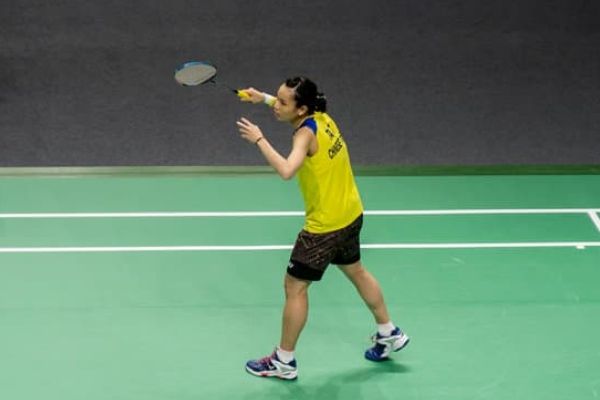
Your opponent can serve a high, flick, low, or drive serve. You got to be half ready for a high serve and half ready for a low serve. Therefore, you’ve got to be ready to move aggressively backward or forward to receive and return the shuttle efficiently.
Let us now discuss how to return each type of serve specifically.
How To Return A High Serve In Badminton?
A high serve is executed when you want the shuttle to land at the back end of the court. The idea of a high serve is to move you away from your base position into the rear end of the court and also minimizes the chances of your attacking play. Does a thought come to your mind that if you are the receiver of a high serve, how will you return it?
Well, there are various ways in which you can return a high serve. However, your goal should be to control the rally or at least not give any advantage to the opponent.
Any short high serve that does not reach the rear end of the court is a gift and an opportunity to win a rally. You must be very careful with the shot you choose, as a wrong shot may lose you an advantage. The default return of a short high serve should be a smash. This will put your opponent under pressure and will serve as an advantage to you if your opponent is unable to receive the smash.
You can also hit a drop, but this can allow the opponent to reach the shuttle faster, which can be a disadvantage for you.
Assuming if you receive a good high serve then there are three shots you can use to return the service.
Smash
The first one is a smash. If you are a strong player who is comfortable with smashing, then you can go ahead with this shot. However, you must ensure that you can cover any likely returns from the opponent. You must also be aware that it takes longer to recover from a backcourt smash. Therefore, it’s better to aim at an angle and play the smash with a little less power.
Drop
The second shot is a drop. A slow drop from the rear end of the court spends more time in the air. This gives plenty of time for the opponent to decide their options. Therefore, a fast drop would be a better option. Also, using a bit of deception can delay the opponent in reaching the shuttle. Therefore, they will be forced to play a lift to recover.
Clear Shot
The third shot you can play is a clear shot. It can force your opponent to move to the rear end of the court, which gives you some time to recover. This is very important as recovering to your base position can give you time to think about your next best option.
We’ve learned how to return a high serve in badminton. Now, let’s see how we can return a low serve.
How To Return A Low Serve In Badminton?
A low serve is when you want to deliver the shuttle near the service line of the opponent. It is usually played in the men’s singles and doubles category. Considering that the shuttle moves just over the net, there are only two possible shots that you can return to your opponent. The shots are a net shot or a lift.
Net Shot
A net shot is the best option to use if you want to control the rally. However, you should be careful that your opponent can anticipate your net shot and aim to play a tight net shot in reply. This will possibly give them an advantage.
Despite this, there are several advantages to choosing a net shot option. It prevents a lift that could give an attack chance to your opponent. When you return a net shot, you can gain a lift which can allow you to attack. Using deception can give you an added advantage.
However, you must also be aware of your strengths and weakness. When playing a net shot as a return to a low serve, you must ensure that you can move to the rear end from this position. If not, your opponent will understand your weakness and will lift the shuttle to the rear end of the court.
Lift
Using a lift as a return to a low serve will give you time to return to your base position and prepare yourself for the next shot. However, make sure the lift is high and aimed towards the rear end of the court. It will also force the opponent to move to the rear end of the court. If the lift is good enough, the opponent will be unable to put some pressure on you.
If the lift is loose and low, it will give an attacking chance to your opponent.
One tip for a lift as a return is to aim it at the extreme backhand and forehand corners of the opponent. This increases the distance the opponent has to travel into their rear court from their base position.
Now, let’s see how we can return the flick of serve in the right way.
How To Return A Flick Serve In Badminton?
A flick serve is a deceptive serve played in the upward direction mostly in doubles. To return a flick serve, you must be able to travel to the back of the court as soon as possible.
So focus on transferring the weight from the front leg to the back leg and move backward hitting the shuttle with a jump. As you do not get much time to return the shuttle, lead with the elbow into a forearm rotation, and do not move your shoulder.
The shots with which you can return a shuttle can be a straight smash or a drop. Aim for an angle and hit the shuttle. Footwork and presence of mind are very essential to return a flick serve efficiently. Of course, never forget the saying, ‘Practice makes a man/woman perfect’.
How To Return A Drive Serve In Badminton?
A drive serve is a service that travels flat back to the back of the service court. To return a drive serve properly, you will need to practice receiving drive serves. One thing you need to keep in mind is to intercept drive serves immediately so that it does not get past you, forcing you to move backward.
For drive serves aimed at your backhand in your forehand service court, you will need to take your racquet arm behind your head to hit the shuttle. This is commonly known as the overhead shot.
The most common returns to a flat drive serve are a flat downward drive or a flat smash. These returns can make you a winner.
When you receive a higher drive serve, it can be either fast or slow. If it is slow, you will have time to jump back and up to intercept and return the serve.
You will need to respond to these serves in a mixed practice regime where the feeder can serve flick serves too. For the flick serve you must move back immediately, but for the drive serve you must stay intact. Don’t move before you see the shuttle.
Final Thoughts
If you’ve read this far and understood the basic concepts of returning different types of serves in badminton, it is time to put the things that you’ve learned into practice.
Do practice these returns as it will boost your confidence in real-time situations. Finally, do not become predictable with your return of serve. If you play the same pattern of returns, your opponent will reach the shuttle faster having predicted your shot.
I hope this article was helpful to you in improving your badminton knowledge. I would really appreciate it if you would be willing to share this article so that other people can find it.
Thanks for reading!
How to Do the Perfect High Serve in Badminton
Learning how to serve in badminton is really important, and you need to have a few varieties of serves in your arsenal to win rallies. In this article, you’ll learn how to execute the perfect high serve in badminton.
You can do a pretty good job with a good-quality low serve. But, you don’t want to do it all the time. That’ll help your opponent to guess what’s coming and prepare for the return. So, in order to make life harder for your opponent, you need to vary your serves at times. Learning how to do a perfect high serve will be really helpful for that.
Let’s dive right in and learn how to execute the perfect high serve in badminton.
What Is A High Serve In Badminton?
A high serve is a serve in which you want the shuttle to land on the back end of your opponent’s court. The player who does the high serve stands in the front corner of the service court and serve the shuttle in a high, long, and diagonal manner so that it reaches the back end of the opposite court.
Take a look at the below pictures to understand how to execute a high serve in badminton.
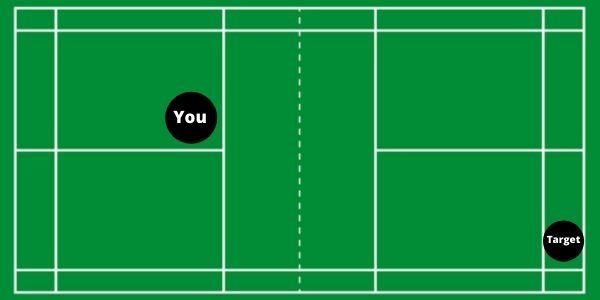
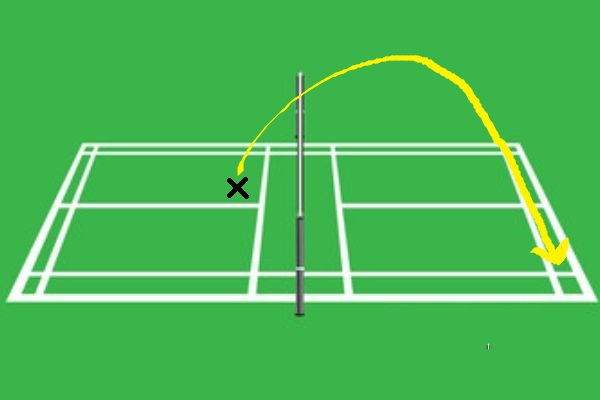
Note that these pictures show you how to execute a high serve only in the singles format of the game. In doubles, there will be a service box at the back of the court, and there won’t be any side-boxes. So, you have to hit the shuttle just in front of that box in the corner. Take a look at the below picture to get a clear idea.
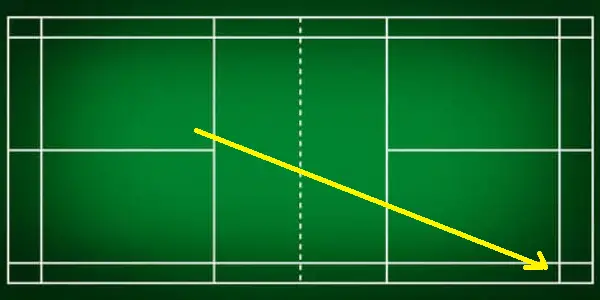
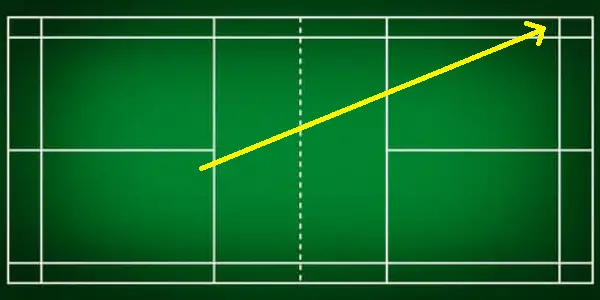
This service is most commonly used in the single’s format of badminton, especially in women’s singles. We can effectively use the high serve during the singles game to move the opponent to the back-end of the court, and thereby opening up his court.
In the doubles format of the game, players often use the low serve as it is more difficult to attack a low serve than any other serves. However, you can use a high serve occasionally to surprise your opponent and prevent him/her from expecting your low serve.
I hope you’ve understood what a high serve actually is in badminton. Now, let’s see the steps to execute a high serve correctly.
How To Do The Perfect High Serve?
Let’s see how you can do a high serve correctly.
- Come near the front corner of the service line (2-3 steps behind the line) and hold the shuttle with its head facing towards the ground
- Stand in a sideways manner so that the side of your body faces the net
- Let go the shuttle from your one hand and swing the racquet upwards with the other hand
- When you do this, your back leg will have to lift up naturally with the toes touching the ground
- Complete the follow through and come back in a position expecting the return
I hope you’ve understood the basic concepts. To make it more clear, watch the following video and understand the whole process.
Why Should You Learn The High Serve?
Learning how to execute different serves is really important in badminton. You can use different serves according to the game situation and opponents. If you have the perfect serves to send to the opponent, you can easily play a mind-game with the opponent and beat him/her in the rally.
A high serve is a great option to use, especially when you’re playing the singles game. As you might have seen in the above video, a high serve landing vertically can be pretty difficult to attack. Also, you can use a high serve occasionally in the doubles game.
If your high serve is not perfect, chances are the opponents will attack you, and you’ll end up losing valuable points. So, it’s better to do some practice and make your high serve as accurate as possible.
Now, let’s see how you can improve your high serve and make it perfect.
How To Improve Your High Serve?
We know that perfection in any shot comes with practice. If you want to make your high-serve perfect, you need to practice it a lot. Once you’ve done the practice, try to implement the serve in game situations.
Initially, you might not get the high serve right, and your opponent might smash it to your court. But, with time and patience, you’ll be able to improve this shot.
One tip I want to give you while doing the high serve is that try to hit this serve to the backhand corner of your opponent. Most people are weak with their backhand, and it will be pretty difficult for them to take the attack to you when you place the shuttle in their backhand area.
If your opponent is not so strong with hitting smashes from the rear end of the court, you can use the high serve to them very effectively. If your opponent is pretty strong with their smashes (mainly tall players), do not use the high serve often. Instead, use the low serve to them.
How To Return A High Serve?
You’ve learned how to do a high serve in badminton. But, it’s also important to discuss the other perspective. What if someone hits a perfect high serve to you, and you want to return it in the best way? Let’s see how you can return a high serve in badminton.
Obviously, if the opponent’s high serve is weak, you can take advantage of it and play an attacking shot. If the opponent serves a good-quality high serve, what you need to do is to get behind the shuttle as fast as possible.
Try to make the judgments very quickly and move according to the path of the shuttle and come behind it. Do not just move casually and waste valuable time. Move your body quickly and get behind the shuttle.
When you’ve come behind the shuttle, position yourself to play the shot you want. If you move quickly, you’ll get more time to settle yourself and hit the right shot.
Once you’ve hit the shot, complete the follow-through, and come back to the base position and get ready for the return from the opponent.
Final Thoughts
A high serve is really important to master, and you don’t want to hit a weak high serve to get smashed by your opponent. I hope this article was helpful to you in learning how to do a perfect high serve.
Now, if you want to learn how to execute the perfect low serve, you can check out this article. Apart from high serve and low serve, there are a couple of other serves in badminton that you can use to trick your opponent. If you want to learn more, check out this article on Different Types of Serves in Badminton.
How to Do the Perfect Low Serve in Badminton
I do play badminton every morning with my friends. But, I wasn’t serving correctly, and hence, I was giving away a significant advantage to my opponents all the time.
To change my luck completely, I decided to learn how to execute the perfect low serve in badminton. I did some research watching several videos from the experts and practicing what they teach. I want to share what I’ve learned in this article.
If you struggle to execute the perfect low serve while playing badminton, I hope this article will help you.
What Is A Low Serve In Badminton?
There are a few different types of serves in badminton. I’m discussing only low serve in this article. If you want to check the different types of serves in badminton, you can read this article.
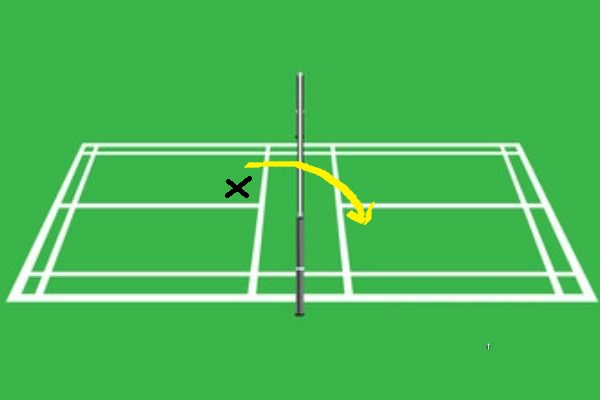
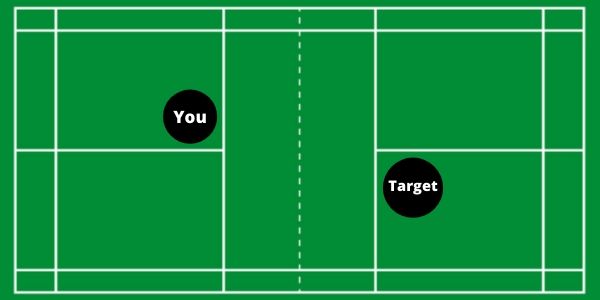
Let’s see what a low serve in badminton is. We use a low serve when we want to deliver the shuttle near the opponent’s service line. A serve in which the shuttle moves just above the net can be considered a great serve.
The shuttle reaches its maximum height when it is just above the net and dips down to land just behind the service line in the opponent’s half. If the maximum height of the serve is far greater than the net height, the opponent will get a chance to move forward and smash it to your half.
Take a look at the following image to understand the trajectory of a perfect low serve in badminton.
How To Do The Perfect Low Serve?
I hope you’ve understood what a low serve is in badminton. Now, let’s learn to execute the perfect low serve so that you’ll get the maximum advantage to attack your opponent out of the rally.
You can execute a low hand serve by using either forehand or backhand.
Backhand Low Serve In Badminton
The back-hand low serve is the typical way of serving in badminton, especially in doubles. Players use this in doubles to prevent the opponents from gaining control of the attack, as the doubles game is all about attacking play. It is also a great serve to use in the singles game.
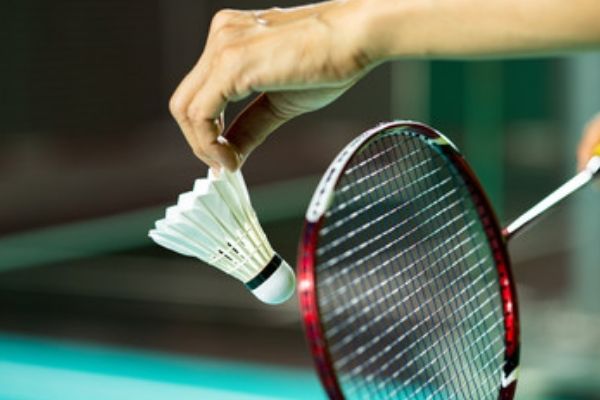
While you perform the back-hand low serve, make sure the shuttlecock is 1.5 m above the surface of the court. Otherwise, it will be a breaking of the service rules.
Let’s see how you can execute a backhand low serve correctly in badminton.
- Stand in the front corner of the service court (just behind the service line)
- Using your fingers gently, hold the cock facing its head downwards
- Move the racquet forward to hit the shuttle and release the shuttle at the same time
- Push your thumb forward in the direction to which you want the shuttle to land
It’s better to watch a video to understand the whole process in the right way. Take a look at the following video and learn the steps to execute a backhand serve in badminton.
If you’ve learned how to execute the perfect backhand low serve, now, let’s move on to the fore-hand low serve.
Forehand Low Serve In Badminton
The forehand low serve is not much often used as the backhand low serve. However, it is a great shot to have in your arsenal if you want to prevent your opponent from attacking right away.
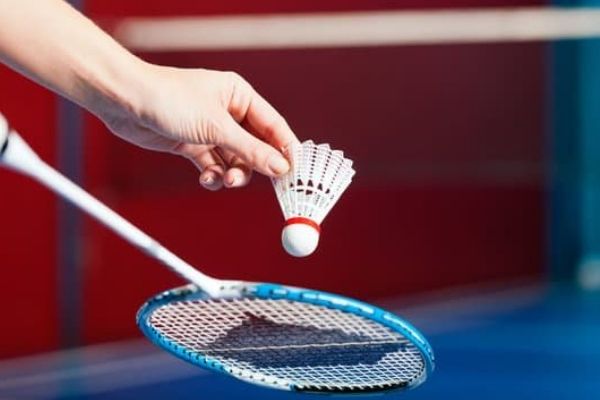
If you learn the basics correctly, you can execute the forehand low serve pretty easily.
Let’s see how to execute a forehand low serve in badminton:
- Stand just behind the service line (front-corner of the service court)
- Hold the shuttlecock by the feathers in the right way by using your fingers gently. The cork head (cork base) must be facing downwards.
- When you release the shuttle, move your racquet forward and push your thumb forward to the exact direction you want the shuttle to land
- The power behind the serve is generated mainly from the slight movement of the wrist and the push of the thumb.
Watch the following video to perform a forehand low serve correctly. Make sure you understand the basic concepts, especially the position of your feet, the way to hold the racquet and shuttle, and releasing of the shuttle in the right way.
Why Should You Learn The Low Serve?
Why should you learn to execute the perfect low serve? Well, Nobody wants to give away the attack to the opponents. If you do not serve correctly, it will be very easy for the opponent to take the attack on you. Hence, it can be difficult for you to gain control of the rally back from that position.
Executing the low serve is highly important in doubles. If you can perform the low serve correctly, the opponents won’t have a chance to hit you back in attack. Hence, you can expect a non-attacking return from the opponent and gain control of the rally.
How To Improve Your Low Serve?
If you want to improve your low serve and make it perfect, there’s no other way than practicing. I suggest you practice this a lot to get a feel for the right positions, movement of the racquet and shuttle, amount of force required, and follow-through.
It takes time to make it perfect. Try hitting the low serve again and again when you do the practice. Once you make it good, use it when you play against your friends. It won’t be perfect for several times.
You might overhit the shuttle or hit it without enough power and lose some points. But don’t worry. Keep doing it again and again until you get it right. Once you hit a few serves correctly, you’ll get the confidence to repeat the low serve more often, and eventually, you’ll make it perfect.
It requires practice and a lot of patience to gain any skill in sports. The more you practice this shot, the better you’ll learn it. When you master this serve, you’ll be able to get control of the rally and take the attack to your opponents.
How To Return A Low Serve?
Now you know how to execute the perfect low serve. But what if your opponent hits an excellent low serve to your court. How can you return a good-quality low serve? Let’s see how you can do that.
If the opponent’s low serve is perfect, it is pretty difficult for you to start attacking the shuttle right away. In that case, one of the best things you can do is to lift the shuttle back to the backhand corner of your opponent’s half.
If the opponent is not so strong with the backhand, which most people aren’t, you can expect a weak reply from your opponent and gain control of the rally.
But at times, this tactic won’t work if your opponent is strong with the backhand. In that case, I would recommend you read this article to learn how to return a low serve in some other ways.
Final Thoughts
The low-hand serve in badminton is one of the most important shots in the game, if not the most important. Mastering this serve will give you a great advantage in most of the rallies you play.
If you’ve learned the fundamental concepts to execute a low serve, now go and practice it. I’m pretty sure that you’ll be able to master this skill quickly. Check out this article to learn how to return a high serve in badminton.
I hope this article was helpful to you. If it was helpful, do share it so that others can find it.
Thanks for reading 🙂
Types of Serves in Badminton [Forehand & Backhand]
In the game of badminton, a serve plays a very crucial role. A player needs to learn how to serve and how to use different variations of serves. One must be versatile and proficient with different types of serves. A good service is your weapon during a game.
You might be wondering what do I mean by varying the service. Service Variation means to serve the opponent in different ways and not just feed one type of service. The reason lies in the fact that if you serve in the same manner repeatedly, the opponent will know exactly where to stand and will return the service in a better way.
A weak serve gives the opponent a chance to execute an attacking shot, which is a loss to your side. Therefore, you should be careful with your service to not lose a point at the time of your service. Each type of badminton serve needs different skills. Therefore, to be executed properly, you must plan to devote a lot of time to practice.
There are mainly four types of serves in badminton: High Serve, Low Serve, Flick Serve, and Drive Serve. Each player must master these types to make their gameplay more diverse and to keep confusing the opponent.
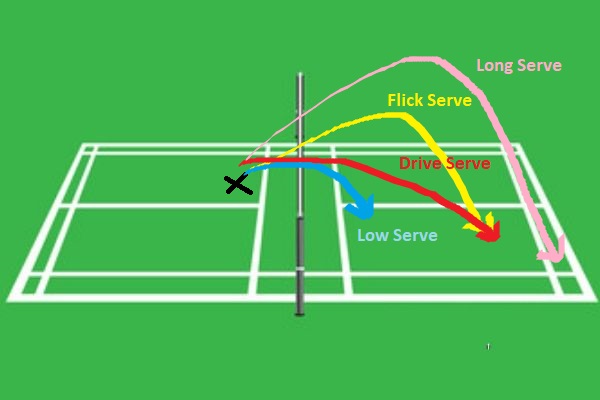
Let’s dive right in and learn each serve in detail.
1. High Serve
This type of service is executed when you want the shuttle to land at the back end of the opponent’s court. The server will stand in his/her position and serve the shuttle diagonally in a high and long manner so that it reaches the back end of the opponent’s court. This service is generally used in the singles format of the game (mostly in women’s singles).
A high serve will prevent your opponent from executing a smash unless he/she can do a jump smash. A clear shot or a drop is more expected from your opponent.
A tip for you is to try aiming the shuttle at the opponent’s backhand area. This will force your opponent to use their backhand. You might be wondering why is it an advantage? The answer is that most badminton players have weaker backhands than forehands.
Let me help you learn how to do a high serve:
- Hold the shuttlecock with its head facing downwards.
- Stand sideways while you serve which means that the side of your body must face the net.
- While servicing, let go of the shuttle and swing your racquet arm upwards. Twist your body to an extent that the body faces the net.
- Move your wrist to a direction where you want the shuttle to land (usually upwards).
- While doing this, you back leg must lift up naturally with your toes touching the ground.
It is very useful to use this serve against opponents who cannot hit strong smashes from the rear end of the court. Use a low serve if your opponent is good at smashes (mostly tall players).
You must refrain from using the high serve in doubles as it is considered a foul if the service enters the baseline. Instead, use a low serve in doubles.
If you want to learn how to do the perfect high serve in badminton in much more detail, click here to find the complete guide.
2. Low Serve
A low serve gives you the flexibility of using either backhand or forehand. Use the style that you are comfortable with and display your strength. Below is the description of the forehand and backhand serve.
When you watch men’s singles, men’s and women’s doubles games, you will observe that in most of the matches, low serves are used as it refrains from giving a chance to smash to the opponent.
Forehand Low Serve
A low service is used when you want to deliver the shuttle near the service line of your opponent. A good low serve will have the shuttlecock moving just above the net. If not, the opponent will have a chance to move forward and smash the shuttle down to you. You can aim the shuttle at the forehead or backhand of the opponent.
A low serve requires a lot of practice. You can start by practicing the service right in front of your opponent.
Here’s how to do it:
- Stand 2-3 feet behind the service line.
- Hold the shuttle by the feathers properly using all your fingers gently. It must face downwards.
- It is important for the distance of both arms including the arm holding the racquet to be similar.
- As you let go of the shuttle, move your racquet lightly while pushing your thumb forward to the direction you want the shuttle to land.
- The power mainly comes from the push of the thumb and the slight movement of the wrist.
Backhand Low Serve
In the backhand low serve, the backhand grip is used and you must be very careful with the tightness of the grip and how much force to put in the swing. It requires immense practice and can be served to the T, backhand, or forehand of the receiver. However, beware of breaking the service rules. The rule is that the shuttle must be 1.15 meters from the surface of the court at the instance of serve.
Push the shuttle with the racquet face and try to make the shuttle skim through the tape of the net.
If you want to learn how to do the perfect low serve in badminton in detail, check out this article.
3. Flick Serve
The flick serve is a deceptive serve that is also played in an upward direction but the altitude is smaller than a high serve. Generally, it is played with the backhand as the backhand has less power than the forehand. This will not allow the shuttle to move to a higher altitude.
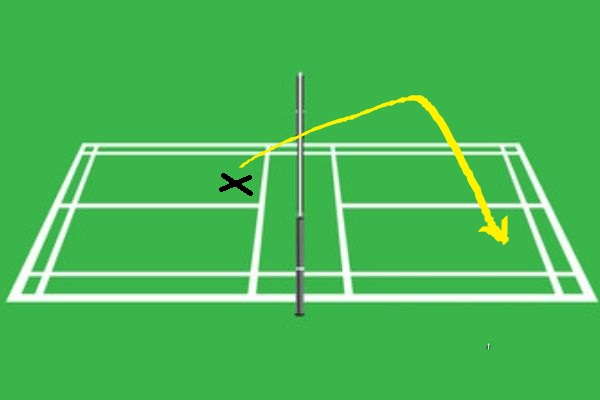
This service can be used to trick or confuse your opponent. In pressure situations, you can use this serve.
A question comes up in the mind that how will it confuse the opponent?
Well, the answer is that when you stand in a low serve position, the opponent will think that you will deliver a low serve and will stand closer to the net. However, when you push your thumb and wrist harder, the shuttlecock flies high and heads towards the back of the court.
However, you must use this serve sparingly otherwise it can be anticipated by your opponent.
You can use this service in singles and doubles but it is more commonly used in doubles. Notably, the flick serve primarily depends on wrist action.
4. Drive Serve
You can use this service to add variation to your game. It is used in both, singles and doubles and is considered an attacking serve. In this, the shuttle will travel at a flatter angle towards the opponent at a high pace.
It will win you a point or force a loose return if the opponent is unprepared for it.
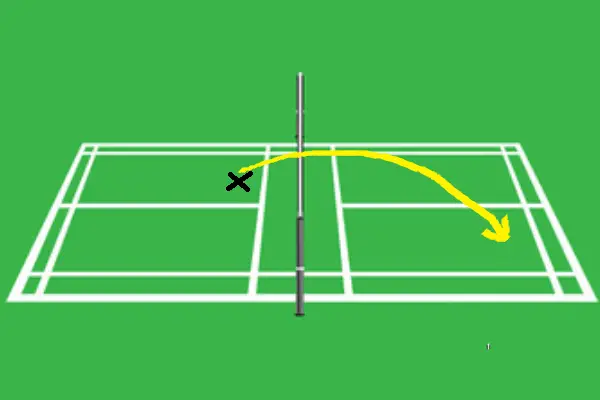
Here’s how you should do it:
- Play with an underarm forehand action
- Stand in a comfortable position and place your racquet a bit below your waist.
- Swing the racquet, hitting the shuttle at a flatter angle.
- Make sure that you contact the racquet below your waist so as to not make a service fault.
In some instances, your opponent can return your serve and it can come back to you very quickly. Therefore, you must always be careful and on your toes.
Final Thoughts
All these badminton serves have their own purpose in different situations. Use them according to the opponent as well. Try to master them and use them when required. If you want to master it, keep practicing until you don’t make mistakes.
You’ll learn how to use these serves effectively only if you do the practice. Do practice these shots and make it perfect. Sometimes, you might need to play the mind game, and it requires patience and practice to execute what you think in your mind.
It’s always good to have different options in your arsenal. You can use these different types of serves in different situations to confuse your opponent. So, go and practice and improve your game awareness to win every single rally.
Now, if you want to learn how to return these different types of serves, if you’re the receiver, then check out this article.
I hope this article was helpful. If so, do share it so that it will reach other badminton enthusiasts as well.
Can Badminton Be Played Outdoors?
Badminton is a professional sport that is played on a rectangular indoor court. But can badminton be played outdoors? In this article, let’s find an answer to this question.
Can You Play Badminton Outdoors?
Many people don’t have indoor courts near their place, and hence, all they can do is play badminton outdoors. In fact, I too have this problem when I’m living in my village. So it is really important for many of us to know whether it is possible to play badminton outdoors or not.
Badminton is a racket sport played indoors at a competitive level. However, people do play the game outdoors as well for fun and recreation. You can play the game outdoors with your friends and have fun. But, professional badminton isn’t played outdoors due to several reasons.
As I’ve said earlier, I do play badminton outdoors with my friends for fun whenever I’m in my home village. We’ve bought all the required badminton equipment and built a badminton court outdoors. We have a proper court with everything needed except an indoor stadium.
Even though we play outdoors, we are still able to play badminton properly and have a lot of fun. Most of the time, the weather here is perfect for playing badminton.
But sometimes, when the weather becomes bad, it is almost impossible to play badminton outdoors. It is really difficult to play the game when there is a breeze, too much heat, or rain.
Why Is It Difficult To Play Badminton Outdoors?
If you’re used to playing badminton indoors, chances are you’ll not enjoy badminton if you play outdoors. The main reason is that you won’t be able to hit the desired shots with perfection. This is because the shuttle is very light, and hence, the air affects its movement.
The shuttlecock is made up of feathers (or plastic) and a cork base, which has about 5 grams of weight. Since the shuttle is lightweight, it will deflect from its normal trajectory even if there is a slight breeze. This movement affects the quality of your shots, and it will be pretty difficult to time the shot to perfection. You will end up losing points.
On the other hand, if there’s rain, the shuttlecock will get waterlogged, making it much heavier. This again changes the overall aerodynamics of the shuttle, which makes it difficult to adjust to the pace of the shots.
Also, the courts will become slippery when it rains. That will make the footwork difficult. You might also get injured when playing on a slippery court.
Safety is one of the major advantages of playing badminton indoors. Indoor courts are often cleaned and moped so that you can play the game without worrying about safety.
On sunny days, the main problem you’ll face is the visibility issue. When there’s bright sun on the sky, it will be difficult to look upwards due to the light directly hitting your eyes. When the sunlight is coming from a direction, it will be difficult for a player/team facing the sun, and the opposite team can easily take advantage of it.
I play badminton with my friends early in the morning before the sun comes out. When the sun comes out, the player/team on one side of the court will face a lot of difficulty in seeing the shuttle. And hence, we stop the game at that time.
When we compare badminton with any other racket sport, it is the sport with the fastest movements. A shuttlecock travels so fast in badminton, and you need to practice hard and develop your skills to control the shuttle. When you play outdoors, you won’t be able to control your shots and the shuttle correctly.
For other racket sports such as tennis, a spherical-shaped ball with a lot more weight is used. A tennis ball weighs about 60 grams. But when we compare that with the shuttlecock, the shuttle is too lightweight. Also, it is built in a way such that it decelerates after being hit. That makes it even harder to play badminton when there is a light breeze.
Even though there are a lot of reasons not to play badminton outdoors, tons of people around the world play this game outdoors for fun. If you take the game casually, you can enjoy this game with your friends in parks, beaches, backyards, or anywhere. You can set up a court anywhere and have fun.
How To Play Badminton Outdoors?
What if you still want to play badminton outdoors? Well, let’s look at some of the best practices you can follow to play the game enjoyably.
The first and foremost thing I want to say is you play badminton when the weather is perfect for playing it. Probably, the best time to play badminton is early in the morning.
In my place, we play badminton in the early mornings before the sun gets too bright. There is less chance of wind or breeze in the mornings.
I’m not sure about the best time to play badminton in your area. The weather can depend on various geographic factors. However, try to choose a time slot in which there are fewer chances of breeze, heat, and rain.
It will be better if the court is covered by buildings or trees or something else to block the wind.
Set up a badminton court with all the required equipment and build a court based on the dimensions of an original badminton court.
When the weather is bad, try to avoid playing the game seriously. You can still play the game casually without swift movements around the court. But keep in mind that there are chances of injuries and you need to take care of yourself when you play outdoors.
People who are passionate about the game still play it even if the weather is bad. We play badminton even when there is rain or slight wind or hot sun. But I don’t recommend that to you. I have had many injuries playing badminton on slippery courts. So I would suggest you take proper care of yourself while playing badminton outdoors.
Final Thoughts
If you ask me whether you can play badminton outdoors or not, I would say “yes” all the time, as long as the game isn’t competitive or professional. Get the required equipment to play badminton outdoors with your friends and have a lot of fun.
Check out the rest of the articles on this website to learn more about the game and improve your badminton skills.
I hope this article was helpful to you. If it was useful, do share it with others so that they can also find it.
Thanks for reading. Enjoy the game!