
Badminton is a physically, mentally, and technically intensive sport that requires skills, agility, speed, endurance, strength, and many other parameters. Your preparation for a particular tournament will directly affect the outcome of your match. It is very important to get your body and mind focused before a tournament.
To win a particular tournament, you will approximately need to play 7-10 matches, which can vary from 40-60 minutes per match. Therefore, you need to train properly before a tournament to sustain all matches and finally win the tournament.
The factors that affect your tournament performance will vary from individual to individual. Some may need to work on their fitness while a few may need to work on their skills.
In this article, I have enlisted various tips that will help you to prepare properly for a badminton tournament.
Proper Nutrition Is Critical For Badminton Players
A proper diet is very important for any individual as it directly affects your performance in your training and during a particular match. Record your weight and consult a nutritionist with the amount of protein intake that you will require. Accordingly, plan your meals with a sustained amount of all forms of nutrition. This will help your body perform better and you will feel fit, healthy, and energetic as well.
You need to maintain a proper nutrition intake before as well as during a match. This is what most players tend to ignore and play empty stomachs. A player needs to eat something at least 1 hour before their match. However, avoid oily and spicy food at this time.
During the tournament, a player should carry some light and healthy snacks like a banana, energy bar/ drink as this will improve the thinking ability.
Sometimes you have to wait the entire day in the match arena and you may forget about your food intake. Therefore, taking care of your nutrition is the first thing you need to keep in mind before preparing for a tournament.
Reduce The Intensity Of Training
This should happen at least one week prior to your tournament. Notably, all elite players reduce the amount of training significantly. Like the famous saying, “After a day without training, the opponent knows. After two days, you start to know. After three days, the crowd knows.”
You might be wondering why is this important. Well, the reason is that a proper recovery time is very critical for your body to go back to its best condition. Many beginner players think that training till the last day before the tournament will help them to perform better. So this assumption is wrong as you need proper body recovery to play your best.
Before your game, control the amount of training and do not overexert yourself.
Hydration For Playing Badminton
Many individuals and players underestimate the importance of hydration in our everyday lives. As a player, you need to take care of your hydration properly before a tournament.
A proper hydration regime is very important as it prevents cramps and any sort of injuries that can influence your play. Moreover, the lack of hydration can lead to dehydration and muscle cramps are more susceptible to dehydration. These cramps can occur in the calves, hamstrings, quadriceps, and anywhere else, and the only remedy to avoid it is by maintaining a proper hydration level in your body.
Notably, you need to drink water during a match as well as it will help you to get calmer which can fasten your thinking process during the match.
Badminton Players Needs To Be Punctual
It is always good to be early than to be late. Due to various emergencies, the timing of the tournament can be unpredictable. Sometimes your matches can start early and sometimes very late.
When you go early to the arena, you will get time to understand the court situations as each court is different from one other. You can test the court if possible and this will surely make a difference in your performance.
Sometimes being early makes you more confident than being late on the court. It gives you time to plan your match and visualize your game plan. Importantly, a warm-up is very essential before a match.
So you need to reach the court at least an hour before your match so that you can warm up properly. Do a proper warm-up so that you are well prepared for an intense badminton match.
Keep It Simple
A week before your match, try to keep your training and workout sessions as simple as possible to avoid injuries or stress to your body. On the day of the match, don’t try to be over-ambitious. Keep the game simple and don’t try to overdo yourself as this would cost you the match.
Your state of mind plays a key role. Don’t panic or stress yourself during a match and play extensive unneeded smashes. Keep yourself motivated and focused and concentrate on just one point at a time.
Before you start a particular match, you get 2 minutes to warm up your shots. At this time as well, keep it simple and try and practice all shots along with your footwork as this will help you to get into action.
Listen To Your Coach
In badminton, a coach plays a very important role to improve and define a player’s performance. As a player, see to it that you listen to all instructions of your coach very carefully during training as well as during the match as this will help you to assess your mistakes and accordingly change your game.
Moreover, most of the coaches train players for a long period of time due to which they know their strengths and weakness. Your coach will guide you according to your style of play which can prove to be an advantage for you as during halftime the coach can share with you certain tips that you can execute in the match.
Also, a coach sits behind you during the match so try listening to their advice as much as you can. Sometimes, when players start losing points, they become nervous and their listening power gets blocked and they stop listening to the coach. However, try to be patient and focused to not allow such a situation to happen to you.
Therefore, take a deep breath after every point and listen to your coach during training as well as during the match. You should maintain a very comfortable equation with your coach and should be able to tell them what you feel so that the coach can accordingly help you with your strengths and weaknesses.
Stay Away From Bad Habits
This is one important element you need to practice before you start preparing for a tournament. Majorly you need to avoid the following-
- Alcohol/Smoking
- Staying up too late at night
- Consuming too much of your time over phone/TV
Well, all this will affect your brain activity and reaction time as well.
Strengthen Your Analytical Mindset
You receive the draws well prior to the tournament. So you know who are you playing against. Analyze the strengths and weaknesses of that opponent and then structure a proper game plan with the help of your coach and try to implement it as much as you can on the match day. Notably, keep watching matches of elite players as this will improve your visualization power.
Mental Strength Is Key For Winning Badminton Tournaments
Every sport comprises of wins and losses. You should train to win and when you lose you should be mentally strong to learn from your loss and come back stronger in the next tournament. Moreover, you need to have the right mental approach during the match.
You need to apply the never-giving-up mindset while playing against a stronger opponent and equally give respect while playing with a weaker opponent.
Keep your mind relaxed and focused on winning and reaching each and every shot will prove to be your mantra to success. Also during your training, keep yourself focused and disciplined as the training is the main element for your on-match performance.
Final Thoughts
Follow all these steps being focused and disciplined. Ensure an optimal amount of training, nutrition, and hydration before the tournament. Keep watching and analyzing matches during your free time and relax your body as much as you can.
Be systematic in your approach and make a list of things done and things needed to be done. Proper preparation for your matches and tournament will definitely guide you to a path to success in your badminton career. Notably, it will positively help in the overall development of yourself and your body.
How To Play Badminton Doubles With A Weak Partner
Whether you are a professional or a club player, most of you might have experienced playing doubles with a weaker partner. Well, situations like this might have gotten you frustrated reasoning you lost a match just because you were paired with a weaker player.
In this article, I will walk you through different strategies that can help you win while playing with a weaker partner.
The things to keep in mind while playing with a weaker player are.
- You want to avoid playing at a higher pace so that your partner can get comfortable with the speed of the game.
- You keep communicating with your partner.
- You don’t want to make it easy for your opponents to target your partner.
- Lastly, you want to avoid running around the court to receive the shuttle.
The best strategy is to keep your mind cool, enjoy the game, and help and encourage your partner. This will help him/her to play their best on the court.
Let me take you across things to keep in mind while playing with a weaker opponent.
Call Rotations
Doubles gets very confusing if there is no proper coordination between you and your partner. A good doubles duo is defined by their movements on the court. It is beautiful to see when partners shift from offense to defense in doubles. However, if not done properly it could lead to chaos and frustration.
Therefore, always call your opponent when it is time to split for defense or call indicating that you are taking charge of the offense/defense accordingly. This will paint a clear picture in your partner’s mind that what he/she will need to do next.
Don’t Play Your Partner’s Shots
It is easy to get frustrated when you lose points because of mistakes made by your partner. However, don’t try to take your partner’s shots as this will end up in a loose return and the shuttle will fly back straight at you.
Instead of getting irritated, empathize with the situation. If you were the weaker partner, would you enjoy being under so much pressure? Obviously, no.
Think logically as a team and leave your partner to play the shots that come to them. It is very demoralizing for a player to see someone else taking his/her shots. Instead, try playing shots that force your opponents to return the shuttle to you and not your partner.
Slow Down The Pace
While playing with a weaker player, slow down the pace of the rally. This can be done by playing drop shots, a strong clear when you and your partner are not ready, and most importantly, lift high and deep.
A differentiating factor between the two skill sets is the speed of execution. Your opponents can play the best shots but they wouldn’t be able to execute them in a slower-paced rally.
By keeping the pace of the rally slow will give your partner the confidence to play at their best possible level. This will also reduce the number of errors which will minimize the risk of losing points.
You Commit Mistakes As Well
No one is perfect. It is very easy to blame your partner for their mistakes but you have to accept responsibility when your team loses points because of you. No matter how much better you are as compared to your partner, you still have flaws. You will still lose points. So, therefore, don’t expect your partner to be perfect.
Most importantly, it is not always your partner’s fault that he/she commits a mistake. Maybe you put them in a struggling defensive situation because of your loose return. Doubles is a team game, so you should not take the mistake personally and respond to that lost point as a team.
Make It Difficult For Your Opponents To Target Your Partner
If your partner is vastly weaker than you and your opponents are trying to constantly target him/her, then play your shots in areas from where it will be difficult for your opponents to target your partner.
Try to play in areas where it will be difficult for your opponents to return the shuttle to your partner. It means, sometimes you have to give away the attack or you have to be extremely good with the attack.
The best area to aim for is in the middle as it will restrict your opponents in terms of where they can play the shuttle. Try to play on the non-racquet side of the opponent and mostly aiming the body.
While defending, try to lift the shuttle high making it difficult for your opponent to hit a cross-court smash to your partner. In fact, if you lift the shuttle high on your side of the court, it will be difficult for your opponents to aim at your partner.
Try and find gaps during the rally to gain further advantage. Also, try to be on the attacking side most of the time as this will give fewer opportunities for the opponents to attack.
Communication
Communication is the most important weapon in the game of doubles. While playing with a weaker partner, don’t show your supremacy. Instead, talk to your partner respectfully on an equal footing.
The best way to approach your partner without them feeling that you are trying to coach them is to ask them what they think about the play. This will make them feel comfortable and valued.
Try getting your opponent focused and involved in the game by questions like:
How can we win a point?
How can we avoid the opponents to attack?
Who should attack and defend?
Such conversations will make your partner feel important in the game. As a result, he/she would give inputs and try to play their best.
Guide Them For Easy Wins
You need to learn to set up your partner for easy wins. This will help them to score some points themselves. Let me explain this to you with an example.
For instance, you force a weak defense from your opponents. In such situations, you can guide your partner to go at the net for an easy kill.
Well, this sounds to be easy than executing it. However, when you set up your attacking pressure in the right way, it will get easy for you to score points. Also, this will boost the confidence of your partner.
Keep The Game Simple
Even if you are the best player in the world, you cannot control a game and your opponent’s playback to you or your partner. You cant even control whether you will win or lose a point. The only things you can control are:
- Service
- Reactions
These are the only things you can control. You cannot control a rally. Rather, you can only influence what your partner does and to some extent, influence your opponents to play a particular shot.
Well, your service is totally under your control. You can choose where to serve from and to, you can choose how to serve (within the rules) and you can choose when to serve. Your service is the best weapon in such a game. Try manipulating your opponents with different types of serves.
Secondly, your reactions and responses are totally under your control. Choose to be in control of yourself, think logically and your game will improve immensely. Once you start getting impatient and lose control, you will not be able to properly focus on the game.
Final Thoughts
Always remember, doubles is a team game and not an individual game. You win and lose as a team. You cannot play doubles without a partner. Therefore, learn to adjust with your partner and keep complimenting them. This will boost their confidence and make them comfortable with you.
No two players can exactly play in the same manner. So don’t expect your partner to play exactly like you. Always be flexible with your partner as this will improve the rapport between both of you.
Most importantly, keep practicing with your partner by trying different variations and positions. This will help you coordinate effectively in real-time situations during a game.
I hope this article was helpful to you in learning something new about badminton. If so, do share this article so that others can also find it.
Thanks for reading. Enjoy the game!
Lets in Badminton: A Comprehensive Guide
Are you wondering about what a let is in badminton? Well, you’ve come to the right place. In this article, I’ll walk you through everything you need to know about lets in the game of badminton.
Without any further introduction, let’s dive right into the topic and see what a let is.
A let is called by an umpire or by a player to halt play. It may be given for any unforeseen or accidental occurrence. It is called to end the rally and replay a point.
However, when a let is called, the score does not change and the same server serves the same receiver. A let can be called by the umpire or the player (in absence of an umpire) to halt play. When a let occurs, the player who served last should serve again.
The difference between a let and a fault is that in a let situation, you do not lose a point and if you make a fault you lose a point.
The issue often occurs due to concerns like a receiver not being ready for a service, no one being certain as to whether the shuttle landed in and out of the court, or if a shuttle from another court or another unplanned instance of interference develops in one’s playing field.
Examples Of Lets In Badminton
Let’s have a closer look at the various situations under which a ‘let’ can be called for. The understanding of these situations is very crucial in your professional badminton career.
According to the rules of badminton, the following situations are considered as ‘lets’:
Serving Before The Receiver Is Ready
When the server serves before the receiver is ready, it shall be a ‘let’. The server must wait for the receiver to be ready before he/she serves.
However, if the receiver attempts a return to the service, he/she will be considered to be ready for the service and it will not be considered a ‘let’.
So if you are receiving the service and not ready, just raise your hand as a gesture to the server to stop and let it down once you are ready. In this scenario, don’t be bullied if the server is rushing the serve, as the rules favor you.
Server And Receiver Are Both Faulted
During service, if both the receiver and server are faulted at the same time, it shall be a ‘let’. The server and receiver may have faulted for different reasons which can happen one after the other. It doesn’t matter who faulted first, if both are faulted then they play a let.
Shuttle Gets Caught On/In The Net
When the shuttle gets caught in the net and remains suspended on top or after passing over the net, the shuttle is caught in the net, it shall be a ‘let’ except on service. This rule applies only after the serve.
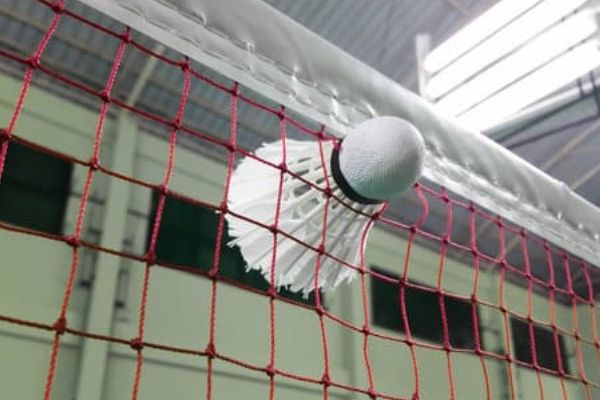
The reason why it is considered a let and not a fault is that in both cases, the receiver has the chance to return the shot but could not do so due to such situations.
However, if the shuttle gets stuck on the net on the hitting player’s side, then it is considered as a fault as it did not go over the net.
Shuttlecock Falls Apart
If during play, the shuttle dismantles and the base completely separates from the rest of the shuttle, it shall be a ‘let’.
This rarely happens when a player smashes very hard so that the shuttle explodes, and in such a situation, it is called a let.
It doesn’t matter if the feathers come out, but if the cork disintegrates from the rest of the shuttle, then it becomes unplayable and unfair to continue with just the cork. In such a situation, the players play the point again with a new shuttle.
Outside Disturbance, Many Shuttles On Court
If in the opinion of the umpire, a play is disturbed or the player of the opposite side is disturbed by the coach, it shall be called a let. There are various instances when such disturbances can happen.
- Stray shuttles or other objects end up in the court in the middle of a rally. In such a situation, players can get hurt and can lead to injury.
- Disturbances can also take place by people taking flash photography or spectators shouting at players to draw attention. This can disturb the players during a rally.
The safety of players must be always considered a priority. The players may not notice any object that comes their way during a rally and may step over it and this leads to injury.
Therefore, always be careful and call out when you see something on your court or the opponent’s court.
Umpire Not Able To Make A Decision
If a line judge is unsighted and the umpire is unable to make a decision, it shall be a ‘let’, However, now in International badminton, the Hawkeye technology has helped make such close calls. At competitions where officials are there, a let can be called if the line judge was unable to see it and if the umpire is unable to decide whether the shuttle landed in or out.
However, in club badminton, where is no umpire or line judge, the players decide as per the best view. However, if no one is sure whether the shuttle was in or out, or if you cannot overcome a disagreement, then call it a let.
When Unexpected Situations Occur
When any unforeseen or accidental situations occur, it shall be called a ‘let’. The situations can be like extra shuttles landing on the court, some invading the court, lights go off, water leakage on the court from centralized air conditioning units, and many more.
Service Court Errors
A service court error also leads to a ‘let’. When a ‘let’ occurs, the play since the last service shall not count and the player who served shall serve again, except in situations where the Law of Service Court Errors is applicable.
A service court error occurs when:
- A player serves out of turn. This primarily happens in doubles.
- A player serves from the wrong service court
- A player, standing in the wrong service court was prepared to receive the service and returns it as well.
If a service court error is made, then:
- If only the error is discovered before the next service is delivered, it is considered a “let”.
- If the error is not found before the next service, then it will not be considered a ‘let’.
- If there is a service court error, the rally is replayed.
- If the service court error is not corrected, then the play will continue without changing the player’s new service courts.
If you don’t know about all the service rules in badminton, I would highly recommend you check out this article. It will help you learn all the important service rules pretty easily.
When Is A Shuttle Not In Play?
A shuttle is not in play when:
- It strikes the net or post and starts to fall towards the surface of the court on the server’s court.
- When the shuttle hits the surface of the court.
- And when a ‘fault’ or a ‘let’ has occurred.
Final Thoughts
Well, these are all the situations under which a ‘let’ can take place. As a player, you must be aware of all these situations or lack of understanding can make you lose points. Also, your opponent can take advantage of various situations during a game if you are not aware of them.
While practicing, observe situations like these, and execute a let in practice games. This will give you a better and deeper understanding of situations that lead to a ‘let’. Keep practicing in a disciplined manner incorporating all the badminton rules, as this will help you in your professional matches.
I hope this article was helpful to you in learning something new about badminton. That’s what this website is all about. Check out the other articles on this site to improve your badminton knowledge.
If this article was helpful, do share it so that other people can also find it.
Thanks for reading. Enjoy the game!
How To Hit A Cross Court Smash In Badminton
A smash is the main ingredient in attacking badminton. Hitting smashes with power and consistency is one of the most important skills that a player should develop to win rallies. But what if we add some flavor to our smashes?
A cross-court smash is a great variety of smashes that you can add to your arsenal of attacking shots. In this article, we will learn how to hit a cross-court smash with power and consistency.
Let’s dive right in.
Table of Contents
What Is A Cross-Court Smash?
First of all, let’s what a cross-court smash actually is.
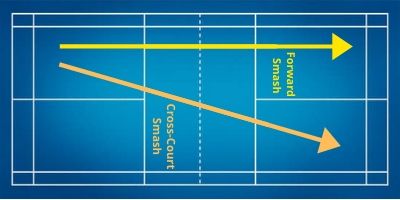
In badminton, a smash hit diagonally to the other side of the court is called a cross-court smash.
The technique used in hitting a cross-court smash is pretty similar to that used in hitting a normal smash apart from a few differences.
A normal smash or forward smash travels straight to the opposite court, whereas the cross-court smash travels diagonally. Hence, for a cross-court smash, the shuttlecock needs to travel a longer distance to reach the net and go over it.
That means, compared to the forward smash, the power behind a cross-court smash will be a little less. The opponent will have a bit more time to react to the shot.
So, in order to make the cross-court smash difficult for the opponent, you need to add a slight deception to this shot. Also, try to hit the shuttle at the highest point possible so that it will travel at a steeper angle.
If you know how to hit the jump smash, that will help. Jumping before hitting the smash will help you to hit the shuttle at the highest point.
If you don’t hit the shuttlecock from a high point, chances are the shuttle will hit the net, and you’ll lose the point. So it is really important to come to the right position, behind the shuttlecock, and hit the shuttle at the highest point at a steeper angle with a little bit of deception.
Grip
The grip used for cross-court smash is the general forehand grip. However, we can twist the wrist just a little bit over to the hammer grip. This is because, with this grip, we can hit more cleanly, and it is easy for us to rotate the arm to send it cross-court.
If you don’t know about the various grips used in badminton, check out this article to learn the fundamentals of grips.
Deception
One way to hit the cross-court smash is to position yourself just like you’re gonna hit a forward smash, but facing the opponent’s court diagonally to your desired target. This is not the right way to do a cross-court smash as it doesn’t involve any deception.
When you turn towards the opposite side, the opponent will know that a cross-court smash is coming and he/she will be prepared for that.
In order to add a little bit of deception, you need to use your arms and upper body in the right way. You need to be in a position so that your side is facing the net. This will help to rotate your body with the full amount of power when jumping and hitting the smash. That will generate more power for the shot.
When you do a scissor jump before the smash, you need to turn your upper body or the hip first, then the elbow, followed by the swing of the arms by rotating your forearm.
You can make it look like you’re going to hit a forward smash straight to the opposite court. The forearm rotation is the key to this deception. You need to rotate the forearm a bit more to push the shuttle cross-court.
If you make this late forearm rotation, the opponent will find it difficult to pick your cross-court smash. At the moment of contact, you can tighten the grip to give more power to the shot.
Footwork
The right footwork is key to this shot as it is with any other shots in badminton. You can’t play badminton well without making your footwork right. If you want to improve your footwork, check out this article which will teach you the basics of badminton footwork.
The footwork for all shots in badminton starts from the base position, which is the center of your court. If the shuttle is at the back corner, the movement starts with a directional split-step towards the backcourt. Then, you need to make a few steps to the corner and be ready for hitting the smash.
You’ll deeply understand the technique of hitting a cross-court smash if you watch all the required steps in a video format. Check out the following video and learn the technique.
This is by far the best video I could find online on teaching the cross-court smash. But it needs a lot of practice to execute the shot correctly. So make sure you understood the technique and try to practice it as many times as you can. You will be able to master this shot easily.
Final Thoughts
Cross-court smash is learnable, and you can definitely make it work if you can practice it many times. We can see that the top players in international badminton like Lin Dan and Kento Momota play the cross-court smashes very accurately and with a bit of deception as well.
But what we don’t see is the amount of practice that they’ve done to make the shot perfect. It takes time and practice to make it perfect. Once you are comfortable with hitting the shot in practice sessions, try to implement the shot a few times in match situations. Gradually, your subconscious mind will master the technique, and it will be second nature to you.
So learn and practice. Hopefully, you’ll become a great exponent of cross-court smash in the near future.
I hope this article was helpful to you in learning some new things related to badminton. If it was helpful, do share this article so that others can also find it.
Thanks for reading. Enjoy badminton!
How To Hold A Badminton Racquet [Gripping Techniques]
The game of badminton is built on several techniques. The first and foremost technique is the grip while holding a badminton racquet. Ask yourself before entering the badminton court whether you are holding the grip properly. Well, a proper grip is essential to develop and improve all types of strokes in badminton.
Many times, players get carried away with the game and forget the most essential thing – a good badminton grip. This results in poor performance and making multiple mistakes during the game.
A good badminton grip helps in effective wrist movement during your game. It can help to reduce injuries, increase the range of shots, and produce more efficient hits.
Most of the badminton shots rely on your wrist technique, therefore, it is very important to grip your racquet correctly. When you grip your racquet in the wrong manner, some of your movements can be restricted which can affect your game. It can limit the range of strokes in a dynamic badminton game.
Hence, grip your racquet correctly so that you can correctly learn badminton and enhance your performance. It will also boost your confidence while you grow in the game.
A simple and correct way of holding your racquet is as easy as a ‘friendly handshake’. Imagine the grip of your racquet as someone approaching you to shake your hand. Go ahead and hold the racquet as if you are shaking that person’s hand.
Your thumb must rest against the wider surface of the grip while the rest of your hand holds the racquet as if shaking a person’s hand.
Few things to remember while you hold the racquet:
Do not hold your racquet tightly. You have to keep changing your grip during a game. If your hold it tightly, it will affect the flexibility of your wrist. This will not allow you to change your grip on time.
Use only your thumb, index, and middle finger to control your racquet. Your last two fingers must rest on the grip to balance the racquet. This will increase the flexibility of your wrist.
Also read: Badminton Grips: Types and Criteria for selection
Grip Techniques In Badminton
In this article, I will introduce you to the different types of grips and how to make the best use of them in badminton. Let us dive into a clear and simple explanation of the angles and position while holding different types of grips.
Forehand Badminton Grip
This is the basic grip in badminton. It is used to hit forehand shots.
Start with holding the racquet using a ‘handshake grip’. Do not hold tightly. You should be able to move and twist the racquet with flexible wrist movement.
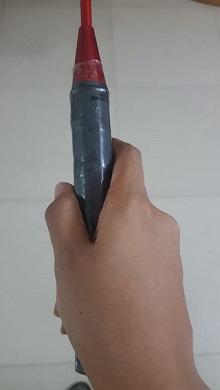
In this grip, your thumb does not have to necessarily press against the wider surface of the grip. This is because the index finger is the one that controls the racquet in this grip. Your index finger will help to push the racquet forward while doing a forehand stroke. However, rest your thumb comfortably on the wider surface so that you can change the grip easily.
Only when you are about to strike the shuttle, hold it tightly. This grip is used in all forehand and overhead shots. A good guideline for the grip is to form a ‘V-shape‘ between the thumb and index finger, and the lowest section of the V should align with the head of your racquet.
Make sure the index finger is curled around the handle and not straight under any circumstances.
It is very essential to master this grip as it will be your first-hand support in the game. Remember to always keep it easy and relaxed. Master the forehand technique to move ahead with the backhand technique.
A forehand and backhand grip is almost the same, the only slight difference being the placement of your fingers.
Backhand Badminton Grip
It is used for making shots that are on the non-racquet side of the body. A good backhand shot depends on how you hold your racquet. The true power of a backhand shot comes from the push of your thumb.
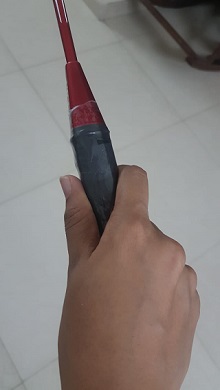
A backhand grip required you to use your thumb. Therefore, you need to rest your thumb a bit tight on the wider surface of the grip. This will make you hit the shot easily across the court. Relax the index finger moving it closer to the middle finger.
Remember, clench loosely on the handle and tighten only when you hit the shot. This grip requires a lot of practice but is very essential for the overall development of the game.
Backhands are usually a limitation for most of the players. Therefore, keep practicing and convert this limitation into an advantage.
Backhand Bevel Thumb Badminton Grip
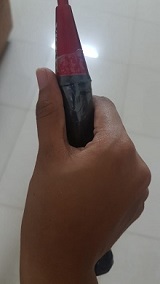
Unlike the backhand grip, bevel grip is more for applying deceptive and defensive shots. In this, place your thumb on the small edge of your grip, not on the entire wide surface. It is used when you have control over the shots and you want to smoothly return the shuttle.
It is combined with loose fingers. However, there should a gap between the index and middle finger. The movement takes place with the help of the thumb and index finger. It is used for low serves and closer to the net shots, usually in doubles.
Hammer Grip
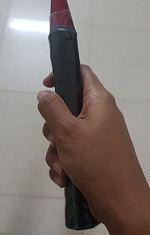
This grip is used when you are executing a normal or a jump smash. It is named hammer because you have to hold the grip like you are holding a hammer.
Start with a normal forehand grip and then rotate the grip swiftly into a hammer grip and clench it tightly while hitting the smash.
Net Tap Grip/Pan Hold Grip
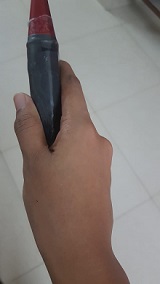
This kind of gripping is needed in the frontcourt near the net when the shuttle is returned very close to the net. At the very right moment, before the shuttle starts to descend, you need to tap the shuttle to take advantage of such a return.
You will require your thumb, index finger, and middle finger to do the tap. Gently hold the racquet with your thumb and fingers creating space between the racquet handle and your palm.
Do not allow your thumb to cover any of your fingers as this would constraint the movement of the racquet. This grip would allow very little movement or no movement at all.
Changing Grip More Quickly
You need to keep changing your grip for different shots. This is because of the position of your body and the position you are taking the shuttle.
Therefore, you must learn how to change quickly from your forehand to backhand grip and vice versa. This enables you to be prepared and hit the shuttle from the highest point. While you keep practicing, you will find yourself changing the grips without even thinking.
Keep practicing while you are sitting idle at home. This sounds crazy but it is very helpful.
Always remember, finger action plays an important role in generating strength for a badminton stroke.
- For forehand strokes, push your index finger forward.
- For backhand strokes, push your thumb forward.
Incorrect Grip
- Your thumb should not cover any of your fingers. This will restrict the movement of the racquet.
- Never extend your index finger. This can lead to injury. Keep it bend and wrapped around the racquet comfortably.
- Do not place the thumb of your hand on the side of the racquet. You will not be able to hit effectively with this grip.
Final Thoughts
While you grip your racquet, ensure you relax your fingers. This is because relaxed grips make it easy for the muscles in the arm to attain flexibility and mobility. This allows you to change your grips quickly. It also adds more power to your shots with the maximum transfer of energy from your hands to the shuttle.
Also, it is advisable to hold the racquet towards the far end base of the handle. This adds more leverage to your hitting power. It takes less power to make powerful shots from the end of your handle than holding it closer to the innermost part of the handle.
Rely on your ring and little fingers for stability and the other fingers should be used for grip manipulations.
Wall exercising is ready to go flexible exercise you can do anytime and anywhere. Keep practicing it while switching from one grip to another as quickly as you can. You will surely feel a positive change in your grip speed soon. Combine theoretical and practical knowledge while practicing and keep improving your game.
I hope this article was helpful. If so, do share it so that others can find it.
Thanks for reading. Enjoy the game!
9 Key Tips For Badminton Doubles Players
In Badminton, doubles has an extremely different style of play than singles. It is often more complex as it involves the coordination of two players. In professional badminton, it is rare to see a player compete in both singles and doubles.
Training for singles and doubles is different in all aspects. Doubles is faster, sharper and the players must be extremely fast to excel in the game. Effective footwork and coordinated formations are the key elements in doubles.
Whether you are a beginner or a professional player, here are a few tips that will help you to enhance your game in doubles.
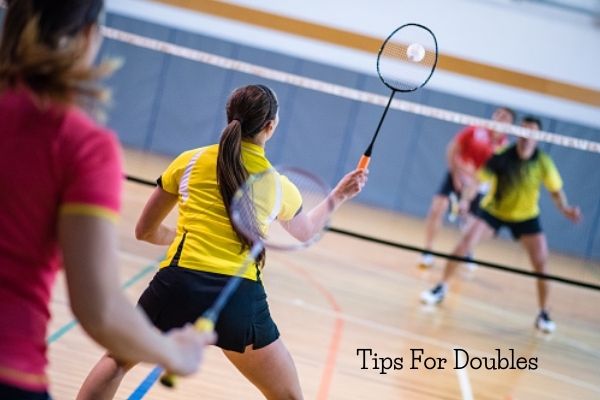
Table of Contents
Communication
In professional matches, you might have seen the doubles partners communicating with each other before a serve. You might be wondering why do they do that? Well, using a variety of serves such as a flick serve, drive serve can help to trick the opponent.
Therefore, to make the partner ready for a particular type of serve return, communication is a must. Otherwise, if your partner is not ready for the return, your team may lose a point. You and your partner can design different signals to communicate with each other.
For example, you can signal 1 behind your back for a flick serve or 2 for a drive serve. By doing this, you and your partner will be prepared for the return of the service and sometimes, you can intercept the return as well.
Serve And Receive
Well, these two strokes are the most important element in doubles. The aim in doubles is to keep the shuttle as low as possible. Moreover, the placement of a service or return can decide whether you will win the point or not.
It is really important to learn the different types of serves in badminton and how to return serves correctly.
The quicker you force a weaker return from your opponent, the higher chance you will get to attack and win the rally.
Formations
There are two types of formations in doubles.
- Attacking formation
- Defensive formation
Master these two formations to improve your performance in doubles. In the attacking formation, the attacker must move at the back of the court and the setter in front of the court. You may be wondering when to use this formation?
The answer is whenever you manage to force your opponents to execute a lift shot to you, you and your partner must quickly shift to an attacking formation. Again, communication is a key element here. Communicate with your partner so that there is no confusion as to who will go behind and front.
In this formation, you and your partner will have two different roles.
- The setter (player in the front) will secure the net position and apply pressure from the net area to force the opponent to continue forcing lifts from the opponent.
- If the opponents hit a poor-quality lift, the setter will intercept the lift with a smash.
- The attacker (player at the back) has one important role that is hit powerful smashes.
In simpler terms, the attacker will cover the back of the court and the setter will cover the frontcourt.
Conversely, when you execute a high lift or a high clear, you and your opponent must move to a defensive position.
In this formation, you and your partner must be side by side in your respective half courts. Both of you must be prepared to defend your opponent’s powerful smashes.
What is Block Defence?
A block defense is a very important shot in doubles. It is practiced when you are defending your opponent’s powerful smashes. To perform a block defense, you receive your opponent’s smash by lifting the shuttle high, straight to the opponent’s baseline.
Executing smashes from the baseline is difficult so when you keep using block defense, it takes more energy from the opponent. It must be high enough to prevent your opponent from intercepting and hitting a half-court smash.
Most importantly, always stay on your toes as when you have your feet rooted to the ground, it will limit your movement in the game.
If you want to learn more about the formations in badminton doubles, check out this article.
Maximum Attacking
In doubles, lifting or clearing is not always an ideal option. It brings you and your partner in a defensive position and at some point, in time, it puts you at a disadvantage to be in a defensive position.
Instead, practice net shots, drives, and half-court push that will keep your opponent in a defensive position which will provide you and your partner maximum chances to win the rally.
However, under pressure situations, it is recommended to hit a lift or a clear shot as it will give you and your partner time to recover and be ready for the next shot.
Movement
Unlike singles, doubles involve the movement of two players across the court. Good chemistry and coordination form a perfect doubles partnership. Both you and your partner must be able to quickly change from an attacking to a defensive formation or vice versa effectively.
You must be ready to take an extra effort to reach the shuttle and not give up. This requires quick movement across the court.
Otherwise, this can lead to confusion and you may lose the rally. Practice these formations and communicate while doing so to speedily improve your performance.
Aim At The Middle Of The Court
An effective practice in doubles is to aim a particular shot in the middle of the court when you are in an attacking position. At this point, your opponents are in the defensive position and are standing side by side.
This will force your opponents to make a quick decision as to who will receive the shuttle. Eventually, a moment of indecision can make them lose a point.
Another instance is when you pretend to hit a smash and instead hit a drop shot in the middle of the court. This again confuses the opponents which can act as an added advantage to your game.
Trust And Understanding
The most important tip for playing doubles is to trust and understand your partner. This is the foundation of any doubles partnership.
In doubles, the role of the two players is mostly well defined. While the attacking player hangs back to smash, the defensive player controls the net. Therefore, do your job and trust your partner to do his/her job. Don’t focus on what your partner isn’t doing, instead, look at the positives of your partner.
Read Between The Lines
Doubles is a game of speed, power, strength, and most importantly, skills. You and your partner must be able to adapt to different challenges presented by your opponent’s strokes. The ability to understand the playing pattern, strengths, and weaknesses of your opponents is important in doubles as it gives the opponents little breathing space.
Enjoy The Game
In badminton, doubles is equally as important as singles. Under pressure situations, you may get frustrated which will affect your game and also your partner. Therefore, be patient and enjoy the game with your partner. Whether you lose or win, it should not affect your partnership and coordination.
Final Thoughts
The above tips will help to improve and develop your game. However, to get the best version of yourself on the court, keep practicing. Increase your training hours with your partner. This will help you become more comfortable with each other which will make it easier to trust and coordinate with your partner.
Training and tactics will push you to become a good doubles player. You have to be dedicated, disciplined, and diligent to push yourself on the court to get your desired results. Prepare for longer rallies and love the game and your practice sessions.
I hope this article was helpful to you. Thanks for reading!