
A shuttlecock, also prominently called a bird/birdie, is used in the sport of badminton. There are two types of shuttlecocks-feather and synthetic. However, in professional matches, only feather shuttles are permitted while synthetic shuttles are good for non-professional players for everyday practice.
So how long does a shuttlecock last on average? Well, the longevity of a feather shuttlecock totally depends on whether you are a professional or beginner player and also on your style of play which can be aggressive or defensive.
Usually for professional players, a shuttlecock can last for 1-2 games, and sometimes it can break in one powerful shot as well. In professional matches, you might have observed players taking new shuttles after almost one or two rallies. Differently, the level of aggression is comparatively lesser in beginner-level matches due to which their shuttles can last for 5-6 games.
A feather shuttlecock is made up of feathers that are embedded into a rounded cork. The shuttlecock is conical in shape which makes it extremely aerodynamically stable.
The price of a feather shuttlecock tube varies from brand to brand but it is usually expensive. Moreover, if even one feather breaks, the entire shuttle gets damages and you cannot use it again. So, in this article, I will guide you as to how to make your shuttlecock last longer.
Factors that affect the durability of shuttles:
Well, many factors can affect the durability of your shuttles.
- Humidity level
The humidity level is a major factor that affects the durability of a feather shuttlecock. Dry conditions during winters make the feather shuttles brittle due to which they can break down easily. Whereas, during summers when the humidity is high, shuttles tend to not break easily. Below I have explained how to increase the durability of the shuttle under dry conditions.
- Quality of shots
Advanced and professional players are quite used to the proper technique of hitting the shuttlecock due to which it does not break easily. However, beginner players tend to use up more shuttles as they are not very much accustomed to the proper technique.
- Choice of quality of shuttle
Some players tend to change the shuttle even though if only one feather is broken. However, some players use the shuttle until many feathers have detached from the base. So it depends upon you how long you are comfortable in using the shuttle. Try to sustain with it till the shuttlecock finally gives up.
- Playing Style
The two playing styles in badminton are- aggressive and defensive. An aggressive style player will use more smashes and heavy shots which will reduce the life of the shuttle. Sometimes, a shuttle breaks down even in one hard smash. However, players with a defensive style of play can make the shuttle last longer as they don’t force powerful shots on the shuttle.
How to increase the life of a shuttlecock?
So here comes the main question as to how to increase the life of the shuttlecock. Many players get exhausted financially buying shuttle tubes again and again. However, here are some tips that will help you to increase the durability of the shuttle so that you can use them longer.
- Steam Treatment
Like I told you earlier that in dry conditions, the shuttle tends to get brittle due to which it breaks faster. In such conditions, a steam treatment will help to increase the durability of the shuttle. Steaming helps to fill moisture into the feathers of the shuttle which helps the shuttle last longer. Remember to only steam the shuttles that you will use in your next training and not all of them as the moisture diminishes over time.
For the steam treatment, you need to boil water in a kettle and while the water is being boiled, remove the lids of your shuttlecock tube and hold the tube directly above the kettle to allow the tube to capture the steam. The shuttles should point downwards while capturing the steam and once the steam emerges on top, then close the lids of the shuttle tube.
Oversteaming can lead to irreplaceable damage to the cork of the shuttle so don’t steam the shuttle tube for too long.
Modifying the speed of the shuttle
Well, modifying the speed of the shuttle is not commonly permitted in professional matches. However, in your practice and recreational play, you can alter the speed of the shuttle by checking its normal speed first.
If the shuttle is too fast, you need to tip the feathers of the shuttle outward to make it slow. So first you can tip every fourth feather and then check the speed again. If it is yet fast, then you can go on to proceed to tip every second feather of the shuttle.
Caution: This is an irreversible process, so be very careful while doing it.
Differently, if your shuttlecock is too fast, you need to do the opposite. You will first tip every 4th feather of your shuttle inwards and if the shuttle is yet slow you can tip every second feather to make it faster.
Purchase a humid cap
This is an expensive option as you need to buy a humid cap also known as Humidome and replace it with the original cap of the shuttle tube. As the name suggests, it keeps the shuttles humid with the help of beads that are integrated into the cap. Keep the cap in clean and distilled water for at least two hours and the beads will absorb the water. With this, place the cap and the beads will maintain the humidity level for a couple of months.
Additional Tips
- Do not store the shuttles under dry conditions as the heat can dry out the shuttle. This makes it brittle due to which the feathers can break easily.
- During play, always take care to align the feathers of the shuttle properly after every shot.
- Whenever you observe a damaged feather, remember to pluck it out immediately as such feathers can affect the flight pattern of the shuttle.
- Another remedy to increase the life span of the shuttle is to keep them in your bathroom while taking a hot shower bath. The humidity level of shuttles would increase due to this.
- Use damaged shuttles for exercises as the shuttle precision
- does not matter at that time.
- Use good quality shuttlecocks. According to me, Yonex and LiNing provide the best quality shuttles. However, Yonex shuttles are predominantly used in professional matches due to their superior quality so go ahead by buying a good Yonex shuttlecock tube.
- Many professional clubs have a humid cupboard where they store the shuttles. Well, this is an expensive option and can be used only if you are dealing with a good amount of shuttles.
- If you forget to steam, you can dip the tips of your shuttlecock in water before practice to make them last longer.
Final Thoughts
The main idea to keep your shuttlecock to last long is to maintain the humidity level of it and not use them while they are dry. Dryness will make them brittle and your shuttles will break easily due to it.
Therefore, take care of shuttlecocks and use all the mentioned tips in this article to sustain your shuttles for a considerable time. Moreover, use good quality shuttlecocks as the quality also plays an important role in your matches.
Don’t get afraid due to the cost of the shuttles. Instead, use them smartly and make the best use of them by increasing the lifespan as this will indirectly save your money.
How To Become A Badminton Umpire – A Complete Guide
Umpires are technical officials that maintain the integrity of the sport and ensure that the game is played to a set of predefined rules and regulations. This career is especially for those individuals who can make judgments and take quick decisions during the course of a badminton match. Moreover, umpires need to be people-friendly and should be comfortable working in a team along with other umpires and referees.
If you want to become a Badminton Umpire and don’t have any idea about the process and guidelines, then this article is a must-read for you.
How to become a badminton Umpire?
The first step in becoming a badminton umpire is to achieve the training at the local level and seek additional training with regional and national associations. After doing this, you need to prepare for an assessment to become an accredited umpire. This can be done after you complete the training course.
Moreover, before becoming an international umpire, you need to achieve the highest national qualification. Go through your respective national and regional websites to find out more information as it is different for different countries.
What is the role of an umpire?
The umpire has the authority of a particular match and is in charge of the court and he/she ensures that the match is conducted according to the formulated rules and laws. The umpire makes decisions on player faults or lets. Moreover, the umpire takes into record any incidents of misconduct and reports it to the referee.
The umpire’s jurisdiction starts from when the players enter the court and ends when the players leave the court. Notably, the umpire reports to and acts under the authority of the referee.
What are the levels of BWF umpires?
The Badminton World Federation has predominantly two levels of umpires-
- BWF Accredited
- BWF Certified- the highest level of umpiring
How to become a BWF Certified Umpire?
The National Badminton Federations train, develop, and assess umpires to the highest national level for the top national tournaments. Later, the umpires who are at a sufficient level and experience may then be assessed to become accredited or certified at the continental level.
The training and development and assessment of the selected umpires are further provided at the continental level. Moreover, the BWF and Continental federations can run umpire training courses and seminars to ensure the umpires have the requisite knowledge to officiate at the highest international levels.
The BWF umpire accessors are responsible for the assessment and appraisal of umpires to BWF Accredited and Certified levels. They also help to lead the respective education and mentoring programs of these umpires. The instruction manual for both BWF umpires is available on the BWF official website.
How are umpires selected?
The process of selecting an umpire may vary slightly for different national associations. However, to become an umpire, you should be familiar with all the laws of badminton including, toss, service, scoring, players, and penalties.
Try and explore by umpiring at the local level and join the national badminton association of your country (for example, in India it is the Badminton Association of India). Train at the local level, and then attend an educational course with a regional or nationally recognized association to officiate at those levels. Prepare for the assessment to become an accredited umpire after you have completed the training course.
To become a BWF certified umpire, the individual must be nominated from his/her particular association. For this, compile your entire record of work and submit it to your accrediting association. To pass the umpiring test, try umpiring a couple of matches at the club level and regional level. Record the entire match and identify your mistakes and try to rectify them in your next matches.
For additional practice, you can make use of the badminton umpire panel to identify the precise vocabulary and notations.
What equipment and uniform are needed to become an Umpire?
An umpire needs to be properly dressed according to the BWF Code of conduct. Sometimes, the equipment and uniform may be provided to you by the organizers and otherwise, you will need to buy it yourself. A few types of equipment and uniform prerequisites required for an umpire are-
- Umpire Shirt- For higher levels, you usually need to buy it yourself or a specialized shirt/sweatshirt can be provided to you.
- Black Trousers- Well, this should be of no problem as most of the individuals own black trousers themselves.
- Black socks- Again a basic color which is easily available to everyone.
- Black shoes- Well, remember to wear a clean pair of black shoes to maintain the integrity of the sport. Moreover, you can purchase a pair of black shoes totally dedicated to the umpiring purpose.
- Coin- A coin is used during the toss before a match. Any coin will do but most umpires prefer a specialized coin for better clarity when dealing with non-native speakers. The simplest type of coins is with colors as colors are understood by anyone from any country.
- Red, yellow, and black cards: Like other sports, badminton also includes a set of penalty cards which are shown to players during a match for several reasons. As an umpire, you will need to have all three cards with you before a particular match starts.
- Stopwatch: A stopwatch will be used to measure the time intervals and interruption lengths during a match.
- Clipboard: This is used to hold the score sheets. However, it will not be required if an electronic scoring system is provided.
- A 2-meter stick: This is used to measure the net height.
Rules and Regulations
To be an Umpire, you need to follow a strict code of conduct laid down by the BWF. Moreover, you need to keep yourself updated with all the new changes and innovations in equipment. Also, if you remain inactive for a period of 2 years, you will be removed from your association. Notably, it is the umpire’s duty to make sure that the court meets regulation standards.
What are the salary prospects for a badminton umpire?
In India, the salary for an established umpire ranges from 75,000 to 1,00,000 per match. Meanwhile, in the UK or Australia, Umpires get roughly £2700 per match. Like this, the salary differs in different countries.
Can a badminton coach become an Umpire?
Definitely yes, a badminton coach can become an Umpire once he/she has completed all the training and experience required to become an Umpire.
What are the benefits and limitations to becoming a badminton umpire?
Benefits:
There are many benefits to becoming an umpire. Some of them are-
- A lot of travel with a chance to visit new cities and countries.
- The job keeps you fit and healthy
- You get to watch your favorite sport right in front of your eyes.
Limitations:
With advantages, umpires are subject to a few limitations as well.
- Lonely travel
- Stress due to fast and heavy decision making.
- Sometimes, umpires are subject to verbal and physical abuse when their decision is not accepted by fans and players.
Final Thoughts
The competition gets tough at the higher level for an Umpire as the badminton industry has seen a rapid rise in terms of development and viewership over the years.
However, it is a good career option overall and best for people who look into other part-time jobs along with being an Umpire. Therefore, dedicate yourself to the sport, connect with your association officials, and become involved with umpiring at all levels as much as you can.
At the highest level, the continental federations recommend umpires as per the quota recommended by the Federation. The nominations are listed in an order of priority which is then consulted with the referees. The sports committee finalizes the list which is then approved by the BWF. Finally, the federation issues an invitation to only those who have been approved.
Keep learning, practicing, and stay updated with your association and worldwide reforms to successfully become a badminton Umpire.
References: https://corporate.bwfbadminton.com/technical-officials/umpires/
Is Badminton Hard To Play?
Badminton is one of the most entertaining and fun sports to play with friends. But is badminton easy to play, or is it too hard after all? Well, let’s discuss it in this article.
Without any fluff in the introduction, let me give you the answer right away.
Badminton is not a hard sport to play. Even though playing professional badminton is physically demanding, you can play badminton pretty easily if you’re playing it for fun. All you need is a friend, two rackets, a shuttlecock, a net, and a badminton court.
But if you’re considering it seriously, either for taking as a profession, or playing it for fitness purposes, there are some other things that you need to understand before choosing badminton. Make sure you stick around.
Let’s dive right in and discuss the topic in detail.
Is Badminton Hard To Play?
Let’s see whether badminton is hard to play based on various factors. The most important one is physical fitness. Does badminton require good physical fitness? Is badminton a physically demanding sport? Well, the great thing about badminton is that you can play the game on different levels.
If you’re a physically fit person with good stamina, you can play badminton in the normal way, just like how the professional players play the game.
In that way, you might need to cover a lot of areas of the court with fast movements and shots. This requires good physical fitness and stamina. If you’re physically weak, and you play against a player with high stamina and fitness, chances are you’ll lose the game for sure.
Hence, if you want to play professional badminton or the highest level of the game, you need to be pretty good with stamina and fitness.
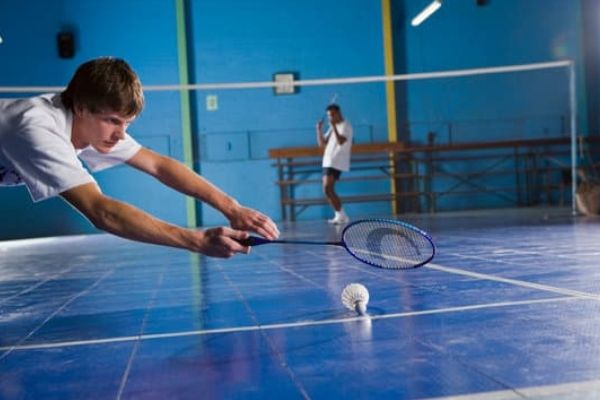
However, if you’re playing the game for fun with your friend who isn’t interested to move around the court a lot, then you can play with him. Both players can stand still and hit the shuttle back and forth and play badminton for fun. That’s the beauty of this game. You can adjust the game according to your fitness level (only if the opponent is also like you).
How Far Do You Run In A Badminton Game?
A typical badminton game lasts about 40-50 minutes. According to various researches, the average distance covered by a badminton player in a singles game is 3.5 to 4 miles, whereas the average distance covered by a doubles player is 1.5 to 2 miles.
As you can see from this fact, badminton players do cover a lot of areas while playing the game.
When we compare badminton with other sports such as tennis, even though the duration of a badminton match is less than half the time of a normal tennis match, the distance covered in badminton is twice the distance covered in tennis. Also, badminton players hit twice the amount of shots hit in a tennis match.
Some people have a doubt about the learning curve in badminton. How long does it take to learn badminton? Well, the game doesn’t require much learning. It is a very simple game with uncomplicated rules. You can understand how to play the game within minutes.
How To Play Badminton?
In this sport, two players can compete against each other or two pairs of players who challenge each other; the couples at a time can be formed by two players of the same sex or mixed man and woman in pairs as well as the opponents.
This sport is practiced in a specific playing field and then observing the rules which have been decided and established by the World Federation.
Each player or pair of players must take their place in the half field assigned to them on one side of the net that cuts the rectangular field, a field delimited by lines.
We must first keep in mind these main game rules:
- The server and the receiver must stay in the diagonally opposite service fields without touching the lines that delimit them.
- The whole shuttlecock must be under the waist of the servant at the moment of impact with the racket (The line around the body at the height of the lowest part of the last rib of the servant).
- The shaft of the servant’s racket must face downwards upon impact with the shuttlecock.
- The server and the receiver must stay in the diagonally opposite service fields without touching the lines that delimit them.
The aim of the game is to hit a shuttlecock with a racket that must pass over the net so that the opponent cannot send it back before it can touch the ground, also making sure that it does not touch the ground outside the limits of the field.
Each time this happens, the player or pair earns one game point. The first player or pair who reaches 21 points wins a set.
If both have 20 points in a draw, then the game continues until there are two points ahead of the opponent.
If the score is 29 even, the athlete with the 30th point wins the game.
An entire Badminton match can consist of an odd number of sets that will be decided in advance, although normally there are always 3 sets, we could find 5, 7, 9 among friends. We can decide the number we want, as long as it is an odd number. In professional badminton, 3 sets are played normally.
The winner of the match will be the one who wins more than half of the sets. So if there are 3 sets, we win if we win 2 sets; if there are 5 sets, we win with 3 sets awarded; in the case of 7 sets, we have to win 4 and so on.
Types of Shots Used In Badminton
As in other similar games, such as tennis, here too, we can use different types of shots to get the point.
The most important are:
- “Clear“, which consists of a single stroke of the shuttlecock and is used to send it to the back of the court in such a way as to obtain an opponent’s retreat as much as possible; Clear can be defensive or offensive. More precisely, we would call it offensive, if the trajectory is rather tense and consequently fast, while it will be defensive if the trajectory is high and consequently slow.
- “Drop“, is the shot that tries to send the shuttlecock as close as possible to the net, using little force in the shot from the back of the field, also, in this case, it can be offensive or defensive. In the “defensive”, the trajectory is slow and falls very close to the net. Instead, in the “offensive”, the trajectory is tense and faster, and the flywheel falls a little farther than the net.
- “Smash“, it’s the shot that is performed almost exclusively with a jump; this is certainly the fastest shot of this sport where the shuttlecock can reach even the 300 Km per hour speed.
- “Lift“: The player to beat from the baseline uses what is called the “Lift”, also here it differs in offensive and defensive. The lift is, therefore, the technique with which the flywheel rises which in the “defensive” will be high and seems like “a bell trajectory” while in the “offensive” the shot will be tense and fast to give the opponent less and less time to return to the center of the field.
- “Cut“, also called “Spin Drop” is a shot that starts from under the net and tries as much as possible to send the short and low shuttle to the other side, it is so-called because, through a certain movement, the shuttlecock turns on itself while making its trajectory.
- “Kill“: this shot constitutes the net closure, comparable to the smash.
There are many others, and mostly they are variants that modify the playing style and the technique of the athlete.
This sport of unparalleled fun embodies the characteristics of many other sports such as tennis, volleyball, etc.
It is a real footwork game since the speed of the movements is fundamental; knowing how to best use your legs by covering all corners of the pitch with little energy wage helps the athlete to be a true and skilled player.
It’s a sport suitable for anyone, in fact, anybody. It does not only require physical power, but agility, cunning and quick reflexes are necessary. All these characteristics can also be acquired over time by practicing this sport, especially from an early age.
Being a varied and complete sport, it guarantees the athlete benefits on joint mobility, coordination, dexterity, reflexes and helps to release stress. This discipline helps in communication and collaboration as well.
Final Thoughts
Badminton is not a complicated sport. It is rather a very simple sport which can be played for fun by anybody within any age group. However, if you’re taking the game seriously, you need to be pretty good with fitness (both physical and mental) and stamina. If you have the toughness, you’ll definitely level up your game.
I hope this article was helpful. If it was, do share it so that others can find it as well.
Thanks for reading. Enjoy the game!
Top 8 Most Prestigious Badminton Tournaments
Badminton Tournaments are categorized into 3 grades by the BWF. The amount of world ranking points depends on different grades and levels of the tournament. The Grade 1 tournaments are the BWF Major events that fetch the greatest number of points and Grade 3 tournaments award the least number of points.
In this article, I have enlisted all the Grade 1 tournaments categorized by the BWF. These tournaments gift the greatest number of points but there is no prize money entitled to the events.
The most prestigious tournaments are the Summer Olympic Games, BWF World Championships, Thomas Cup, Uber Cup, Sudirman Cup, World Junior Championships, Para-Badminton World Championships, and BWF World Senior Championships.
While the Summer Olympics is held once in every four years, the BWF World Championships are held every year and gifts the highest-ranking points to the players. The Uber Cup, Sudirman Cup, and Thomas Cup are team-based events where players play for their respective countries.
Let’s look at each of them in detail.
Table of Contents
Olympic Games
The 1992 Summer Olympics introduced Badminton as an official sport which was held in Barcelona, Spain. Since then, badminton is part of seven editions of the Olympics till now. Overall, 69 different countries have appeared at the Olympic badminton competitions with 19 of them appearing all seven times.
Badminton first appeared as a demonstration sport at the 1972 Olympics. In its 1992 inaugural Olympics, only four events were held, singles and Doubles for both men and women. There were four medals awarded with 2 bronze medals. The 1996 Atlanta Olympics saw the joining of mixed doubles category and from here only three medals were awarded to the players.
The BWF ranking list is used to determine the qualification for the Olympic event.
Generally, 29 singles players and 19 doubles pairs are selected. Usually, each participating nation is allowed to send only one player from each category but there are exceptions if-
- If the nation has two players at the top in the ranking list, then both of them are allowed to qualify.
- Moreover, the host of the Olympics can select one male and female singles player in each of the singles event. So, if the country has players in the top-ranking list, then more than 1 player will be able to represent the country.
BWF World Championships
The BWF World Championships is a tournament that offers the highest-ranking points along with the Summer Olympic Games. The tournament started in 1977 and was held once every three years till 1983.
From 1985 it became a biennial event till 2005. Since 2006, it has become an annual event on the BWF calendar with a goal to give more chances for players to be crowned as ‘World Champions’. However, the tournament is not held in the Summer Olympics year.
So far, only 20 countries have produced a medal in the tournament- ten in Asia, eight in Europe, one in North America and one in Oceania.
World Junior Championships
The BWF World Junior Championships is organized by the BWF to crown the best junior badminton player in the World. It is a tournament designed for players below 19 years of age. The Championship is held annually and consists of two competitions:
- A mixed Team Championship (Suhandinata Cup)
- Individual Championships (Eye Level Cup)
Previously, from 1987 to 1991, the tournament was known as Bimantara World Junior Invitational which was held in Indonesia. The first edition of the World Junior Championships started in 1992 which was held biannual till 2006. Starting from 2008, it has been an annual event.
China, Korea, and Indonesia have been the most successful national teams of the Championship.
Para-Badminton World Championships
The Para-Badminton World Championships is a biannual event organized by the BWF. Previously, it was organized under Para-Badminton World Federation (PBWF) before it decided to merge with BWF in June 2011. The first Championship was held in 1998 in Amersfoort, Netherlands.
The para-badminton players with the highest ranks compete with each other across six classifications- 2 in the Wheelchair Sport Class, 3 in the Standing Sport Class, and 1 in the Short Stature Sport Class.
The Tokyo Olympics will be the first Olympic Games to include Para-Badminton.
Thomas Cup (BWF World Men’s Team Championships)
The Thomas Cup is an international badminton competition among teams representing member nations of the BWF. It started in 1949 in Preston, England, and was the idea of Sir Alan George Thomas, a highly successful English Badminton player of the early 1900s. Initially, it was a triannual event but since 1982, the tournament is conducted every two years.
The matches are broken down into 3 singles and 2 doubles matches and a total of 16 teams compete in the championship. Moreover, the tournament is played parallel to the Women’s Team Championship, known as Uber Cup.
Since its inception, only five countries have won the Championship- Indonesia (13 titles), China (10 titles), Malaysia (5 titles), Japan (1 claim), Denmark (1 title).
Uber Cup (BWF World Women’s Team Championships)
Similar to the Thomas Cup, the Uber Cup is a major international badminton competition that is contested by women’s national badminton teams. Started in 1956 as a triannual event, is now a biennial event from 1984.
The tournament is named after a British women’s badminton player, Betty Uber, who in 1950, had the idea of hosting a women’s event similar to the men’s Thomas Cup.
Since its inception, only five countries have won the title- China (14), Japan (6), Indonesia (3), United States (3), Korea (1).
Sudirman Cup (BWF World Team Championships)
The Sudirman Cup, commonly known as the BWF World Team Championships, takes place every two years. The Cup is named after Dick Sudirman, a former Indonesian Badminton player and founder of the Badminton Association of Indonesia.
The first Sudirman Cup tournament took place in 1989 in Indonesia. There is no prize money, the players play for their respective country to earn BWF World Ranking points and prestige.
There are a total of five matches in every tie, which consists of men and women’s singles, men and women’s doubles, and mixed doubles.
The format involves 12 teams split into 4 groups of 3 teams each. The top two teams from each group advance to the quarter-finals which is a knockout featuring 8 teams.
To date, there are only three countries that have been successful at winning the Sudirman Cup- China (11), South Korea (4), and Indonesia (1).
BWF World Senior Championships
The BWF World Senior Championships is a tournament sanctioned by the BWF. The tournament started in 2003 and has been held biennially since then. It takes place in odd-numbered years on a date decided by the BWF. The winners are awarded gold medals; however, it does not offer any prize money.
The following age groups compete across five disciplines- 35+, 40+, 45+, 50+, 55+, 60+, 65+, 70+. Member nations are allowed to enter 4 male and female singles players, 8 male and 8 female players in doubles, and 4 male and 4 female players in mixed doubles. England leads the medal count with 228 medals so far.
Different Formats Of Badminton Tournaments
Single Elimination
This is the most common format in which once a player loses a match, he/she is eliminated from the tournament altogether.
Tournaments: All BWF Superseries
Round Robin
In this format, players/teams are put into different groups and each player plays against every other player in the group. The top players from each group compete in the progressive rounds.
Tournaments: Olympic Games and BWF HSBC World Tour Finals
Team Play
In a team play, multiple matches are played in best of 5 series which includes all the five disciplines in badminton.
Tournaments: Uber Cup, Sudirman Cup, and Thomas Cup.
Ranking Points For Grade-1 Tournaments
Let’s look at the ranking points awarded for players in BWF Grade-1 badminton tournaments [Source].
| Position | Points |
|---|---|
| Winner | 13000 |
| Runner Up | 11000 |
| 3-4 * | 9200 |
| 5-8 | 7200 |
| 9-16 | 5200 |
| 17-32 | 3200 |
| 33-64 | 1300 |
| 65-128 | 650 |
| 129-256 | 260 |
| 257-512 | 130 |
| 513-1024 | 65 |
* Olympic third-place winner will get 10100 points. The fourth-place winner will get 9200 points.
Final Thoughts
All these major tournaments are well recognized across the World. They provide exquisite exposure and experience for players to play against different players across the World. Moreover, they help to improve the World rankings significantly.
It is a dream of almost all players to win awards in these tournaments. The tournaments provide a great platform for players to play for their country and make the nation proud.
I hope this article was helpful to you. I would appreciate it if you’d be willing to share it.
Do you know how badminton as a sport evolved over the years? Check out the article on The History Of Badminton.
Thanks for reading.
Badminton Quiz – Trivia Questions & Answers
Badminton can be a very tough game to learn because of the terminology and systems that the game uses. Quite often, you may go to play badminton, know one or two rules, but you find that you’ll run into a scenario that you don’t know about.
This can be embarrassing. Never fear! This quiz will help you test your existing knowledge, and hopefully, you can learn something new too.
The questions will be split up into three question sections. Section one will cover general knowledge with short answers. Section two will test your knowledge of the rules of the game and will test your detailed knowledge a little more.
Section three will cover five match-realistic scenario questions that will encourage you to use the knowledge gained throughout the test. Try to hit the recommended scores for each part before moving on. The number at the end of the question equates to how many possible answers there are.
I would strongly encourage you that if there are any terms you are not sure about, make sure to do your own research so you can better your won understanding. I would also recommend that you have a look at some more advanced rules once you’ve completed this quiz.
Have a go and see how well you do!
Table of Contents
Section One – General Knowledge
This section of the quiz is designed to test your knowledge of the game of badminton. It shouldn’t be too hard, but the idea is to make sure you are aware of the very basics before progressing any further.
This section makes up a core part of the rest of the quiz, so try to score above 15 out of 20 as this shows you have good knowledge to pass onto section two. Let’s begin.
Questions
- What object do you hit when playing badminton and what do you hit it with? (2)
- How many ways can badminton be played? What are they? (3)
- What are the different types of badminton strokes? (4)
- What are the dimensions of a singles court? Length and width (2)
- What are the dimensions of a doubles court? Length and width (2)
- Which is the most prestigious badminton tournament in the world? (1)
- How many points are there in a set? (1)
- How many sets do you need to win a match? (1)
- What is meant by the term deuce? (1)
- How many different types of judges are there in a match? (3)
Answers
- Shuttlecock and racquet- These are what badminton is played with
- Three – Singles, doubles, and mixed matches
- There are four main strokes – Overhead forehand, overhead backhand, underarm forehand, and underarm backhand
- The dimensions of a singles court are 13.4m long and 5.18m wide
- The dimensions of a doubles court are 13.4m long and 6.1m wide
- BWF World Championships
- Twenty-one
- Two out of three
- When a score is level at 20-20
- Three – Chair umpire, line judge and a Service judge (There is also a tournament referee, but this is not a specific judge to the game).
Section Two – Rules Of The Game
This section of the quiz is designed to test your knowledge of the game and any scenarios that might happen in a game of badminton. Answering these questions in as much detail as you can will lead you on nicely onto the final part of the quiz.
Try to score 15 out of 20 or above to progress onto the next section. If you don’t do this first time around, give it another go!
Questions
- When the shuttlecock goes out of play, what do we call this? (1)
- What will happen if the shuttlecock hits a player? (1)
- Is it a violation to double hit the shuttlecock? (1)
- Where do I serve too in badminton? (1)
- What happens if I hit the net on my serve and the shuttlecock goes over? (2)
- How many serves do you get per rally? (1)
- What are the rules for a legal serve? (3)
- Name the different lines in a badminton court. (7)
- What happens when the score is 20-20? And describe what it is. (2)
- Can you touch the net during a rally? (1)
Answers
- We say the shuttlecock was “out”.
- If the shuttlecock hits the opponent’s body, he/she will lose the point.
- Yes – you are only allowed a single hit of the shuttlecock.
- Diagonally across from your service box.
- If the shuttlecock hits the net and falls short of the service line, then you’ll lose the point. But, if it hits the net and lands and lands inside the service lines, the service is legal.
- One – you don’t get a second serve in badminton.
- The serve must be hit upwards, hit underarm, the shuttle must be below your wrist.
- Baseline, side-line, center line, forwards service line, back service line, singles line out, doubles line out.
- Deuce is played. This is where the players will continue to play until someone wins by two clear points.
- You can’t touch the net or posts when you’re playing a rally. If you do so, your opponent will get one point.
Section 3 – Game Scenarios
This part of the quiz is designed to test your knowledge that you should have gained in a real game scenario. It’s important to answer these questions in as much detail as you can as these scenarios can come up when you play a game of badminton.
Apply all the knowledge that you have learned throughout the test and maybe some of your own knowledge if you can. Try to get all the points available to show that you really know your badminton! Remember, read the scenarios carefully. Try to get more than 6 points out of 10.
Questions
- Jenny and Mark (J+M) decide to play a game of doubles against Jade and Alex (J+A). J+M want to play on a 13.4m long by 5.18m wide court. J+A want to play on a 13.4m long by 6.1m wide court. Who is correct, and what lines come into play because of it? (2)
- Jack hits a forehand smash to Bob. Bob miss-hits the shuttlecock. It hits the frame, then it hits the strings and goes over. Jack stops playing and says it’s his point. Bob argues that it is his point because the shuttlecock went over and hit the floor. Who is right, and why? (2)
- Jessica and Anna are playing in a close set. The score is 20-19, and Anna wins the next point, making the score 20-20. What should happen next? (2)
- Ron is serving to Adam. Ron serves from right to left. He serves underarm, but it hits the net and goes over into the service box. Adam says that it is his point. Is Adam right, and why? (2)
- Rachel and Nina play a point. Rachel brings Nina close to the net. Nina flicks the shuttlecock upwards, and Rachel smashes downwards, hitting Nina. Has Rachel won this point? (2)
Answers
- Jade and Alex are correct. The dimensions bring into play the double side lines.
- Jack is correct because hitting the shuttlecock twice is a violation of the rules. It’s important to make sure that if an umpire is there, they must call it
- Jessica and Anna must play a deuce point. Either Jessica or Anna needs to win by two clear points.
- Adam isn’t correct because if the shuttlecock hits the net, goes over and lands in the service box then it is a legal serve.
- Yes, Rachel has won the point.
A pass score is 36 or above (out of 50). Keep trying until you hit that 36 points, and you’ll be ready to play in no time.
So, there you have it. Twenty-five badminton questions to help you build on your knowledge or gain new knowledge of the game. I would recommend researching some of the points you got wrong, or if you did really well, research some of the more obscure and in-depth rules of badminton as this can give you an advantage.
Final Thoughts
When you start playing badminton, it’s important to make sure you research and understand at the very least basic rules first. The game is so fast that you can easily miss something and lose a point because of it. You will get faster at picking everything up, but this comes with practice and hours of playing.
Taking quizzes like this can really help you gain the basic knowledge that you need, but the most important part is that you are applying it consistently. The only way where you can expand and learn more about the game is to play yourself.
By playing yourself, you’ll learn about new scenarios and how the rules are applied, or you might learn a completely new rule. By constantly playing, you’ll also pick up on rule violations a lot faster.
Hopefully, this quiz has got you on your way to learning more about badminton!
If this was helpful, do share it so that others can also find it.
To enhance your knowledge a bit more, we’ve got a complete guide on the commonly used badminton terms and their simple explanations. Click here to check it out.
Thanks for reading.
Commonly Used Badminton Terms And Definitions
The world of Badminton can be a strange place with some rather odd vocabulary and terminology. If you’re new and inexperienced, then it might be a daunting task to learn the strange terms and vocabulary, let alone trying to actually play the game against someone.
Not to worry, you have come to the right place. I’m going to be going through the most commonly used badminton terms and their meanings in a simple and easy way to understand.
Hopefully, this means you’ll have more time to practice and play instead of being confused as to what your opponent is going on about. All the key phrases and terminology is listed in alphabetical order for your ease of use. Let’s get started!
A
All – Refers to a level score in the game. For example, 7-7 would be scored as Seven all.
Ally – Additional area for doubles matches. The area is extended by 1.5 feet.
Ace – Winning the point without the opponent touching your service. Very similar to tennis but a lot harder to do in badminton.
Air Shot – Missing the shuttlecock completely. Don’t do this!
B
Back Ally – Back boundary line to the long service line. Used for doubles play exclusively.
Backhand – A type of stroke. If you are right-handed, this will be a stroke played on the left side and vice versa if you are left-handed.
Badminton Strokes – Swinging your racquet, commonly referred to as your motion. They are not shots.
Baseline – Marks the outer play area at the breadth of the court.
Baseline Smash – A smash shot from your baseline.
Brush – Used to win points at the net quickly with a different technique. This is a relatively uncommon shot to play as most play a “kill shot”.
C
Carry – The shuttlecock gets stuck in the strings and doesn’t deflect off them. This is a violation.
Centre Line – The line that divides the right and left courts.
Clear Lob – A defensive shot that is hit as far back as possible onto the opponent’s baseline.
Court – The area where the shuttlecock must land. It’s 13.4 meters long and 6.1 meters wide for doubles. For singles, it’s 13.4 meters long and 5.18 meters wide.
D
Deuce – This means the score is 20-20. One player must win by two clear points at this point.
Drive – Fast shot that is played close to the net. It remains horizontal until the mid-court, where it should drop downwards.
Drop Shot – Dropping the shuttle close to the net of your opponent before they can get to it.
F
Fault – A major violation of the rules where you will lose a point. For example, hitting the shuttlecock into the net.
Feint – A pretend shot to try and deceive your opponent.
Flick – Changing your shot from a slow one to a fast shot by flicking your wrist faster.
Follow-Through – Finishing your stroke.
Forecourt – The front area of the court. Also known as the first third.
Forehand – Playing a right-sided shot if you are right-handed and vice versa if you are left-handed.
Full Smash – Hitting the shuttlecock as hard as you can.
G
Game – Getting 21 points before your opponent. This makes part of a set.
H
Hairpin net shot – Your shot starts low, just goes over the net and lands close to your opponent’s net.
Half-court shot – A shot that stays low in the mid-court, mostly used in doubles.
Half Smash – Hitting a smash without hitting the shuttlecock as hard as you can. This is more of a tactical shot to try and move your opponent into an uncomfortable area on the court.
Handle – Part of the racquet that you hold.
High clear – A shot that pushes the attacking player back into their baseline. Mostly a defensive shot.
L
Let – A minor violation of the rules or an accidental occurrence where the rally stops and is played again without changing the positions or scores. For example, the opponent isn’t ready for your serve.
Line Judge – A person who decides if the shuttlecock lands in or out of the court.
Long Service Line – The serve can’t go past this point. For singles, it’s the boundary line at the breadth of the court. For doubles, it’s 2.5 feet inside the singles line.
Love – Where one of the players has not won a point yet. For example, 4-0 would be Four – Love.
Lunge – A shot where you stretch to get the shuttlecock. Mostly happens in the frontcourt.
M
Match – A match has 3 sets (games). You have to win two of them to win. If the score is 1-1, then you play a 3rd set, known as the rubber game.
Match Umpire – The person who enforces the rules and keeps the match running smoothly.
Mid-court – The middle third of the court.
N
Net Kill – A fast shot played from the net that can’t be returned. This is played downwards into the court so that the opponent has little chance of returning it.
Net Lift – A shot played from the net that travels high above your opponent towards the baseline.
Net shot – A shot hit from the net that drops quickly on your side.
P
Passing shot – A shot where you pass the shuttlecock to either your teammate or the opposing team.
Push – A gentle shot that moves the shuttlecock forwards smoothly.
R
Racket (or Racquet) – The specialist equipment you use to play badminton with.
Racket Head – The top part of the racquet where the strings are located that is metal.
Racket Shaft – The connection from the handle to the racket head.
Rally – An exchange of shots from yourself to the opponent.
Rear court – The last third of the court.
Receiver – The person who is is receiving the serve.
Rubber – The third and final deciding game of a badminton match if the score in sets is 1-1.
S
Set – The first person to win 21 points by two clear points wins the set. In badminton, a match is played for 3 sets of 21 points each.
Server – Person who is serving the shuttlecock.
Service court – The area where your shuttlecock must land. The area will be depending on if you’re playing singles or doubles.
Service Judge – The person who judges for faults in the match overall.
Service Over – When a rally is lost, the serve will change over to either yourself or your opponent depending on who served and who lost the rally.
Short Serve – This is a serve that lands short on the opponent’s side of the court, just behind the short service line.
Short service line – This is the line that is 1.98 meters away from the net.
Shuttlecock – The object that is hit back and forth between the two players.
Singles Footwork Base – Also called “base position”, this is where you return to when you have played a stroke. This is normally in the middle of the singles court. This is a singles term.
Singles side-line – This is the area used in singles that measures the width of the singles court.
Smash – This is a stroke that is hit from baseline to baseline mostly. A perfect smash will go over your side of the net and drop quickly on the other side of the net. This is the primary offensive shot that is played overhead.
String Bed – This is where your strings lay on the racquet.
T
Throat/T-Joint – This is where the shaft of your racquet and racquet head are connected.
Tournament Referee – The main decision-maker of the rules. If the umpire cannot resolve an issue with the players, the tournament referee will do so. They are not an umpire, however.
Tumbling/Spinning Net Shot – A normal net shot where the shuttlecock is spinning towards the ground.
W
Wide – When a shot goes out of the court width ways rather than long. The “wide” area depends on if you are playing singles or doubles.
Wood shot – A shot played when you miss the shuttlecock, and it hits the frame of the racquet, not the strings.
So as you can see, an awful lot to learn there. However, some of the words and phrases aren’t really that common, especially in a match, but its always handy to know what they mean.
Try to learn the most basic, relevant, and simple rules, phrases, and terminology first before you start playing. Remember, there should always be an umpire and a tournament referee to help you if you or your opponent don’t understand something or disagree.
However, I think the best way to learn all of these phrases and terminology in the shortest amount of time possible is to actually play badminton even if it is with family or friends! I would certainly encourage you to give it a go.
Badminton is a great game that focuses so much on fitness, reflexes, hand-eye coordination, speed, and flexibility. By having a basic understanding of the simplest phrases, vocabulary, and terminology, you will have access to a sport that you can enjoy both recreationally or competitively.
Your knowledge of everything badminton will improve the more you play!
I hope this article was helpful. Do share it if you think it would be useful for others as well.
Now that you’ve learned a lot about badminton, it’s time to challenge yourself and take the badminton quiz we have created. Click here to check it out and test your knowledge.
Thanks for reading!